The Institute Letter, Spring/Summer 2026

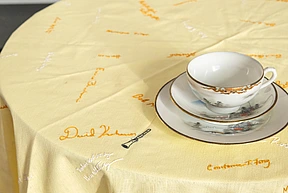
Encounter the humanistic roots of mathematics through a seminar that examines the original texts of Newton, Riemann, and more. Join an astrophysicist as he applies his wandering curiosity to “tidal disruption events” around black holes, while preparing for an impending explosion of new data. Discover the fascinating history of “Labanotation,” a unique system for transcribing choreography that fundamentally reshaped our view of the body. Learn how the engineering challenge of teaching computers to “see” blossomed into elegant developments in pure mathematics. Unpick IAS history with an intricately embroidered tablecloth. Read recent research news spanning the role of disability in the Renaissance to the psychodynamics of modern conspiracy culture.
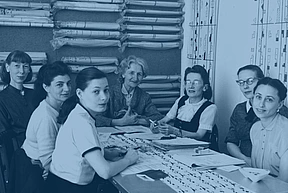
Inspired by her years of ballet training, Whitney Laemmli, Member (2021–22) in the School of Historical Studies, spent her time at IAS investigating the strange legacy of transcribing human motion. The resulting book, Making Movement Modern, reveals how a 1920s dance notation system fundamentally reshaped our view of the body from a vessel of expression into a technology to be analyzed, optimized, and controlled.

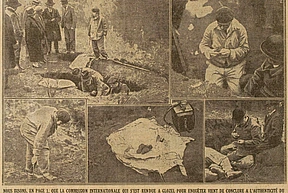
From state-sponsored excavations in Tunisia to debates over Neolithic discoveries in central France, early archaeology was defined by a tension between scientific rigor and public spectacle. Sensations: French Archaeology between Science and Spectacle, 1890–1940, a book by Daniel J. Sherman, Member (1993–94; 2016) in the School of Historical Studies, unearths the long-running historical controversies that forged the discipline as we understand it today.

In a book titled Paranoid Publics: Psychopolitics of Truth, Zahid R. Chaudhary, Member (2023–24) in the School of Social Science, brings psychoanalysis to bear on modern culture’s fraught relationship to truth. Chaudhary argues that unconscious mental forces like our fears and memories might also inform attitudes about truth, and that the unconscious plays a role in political-economic processes.

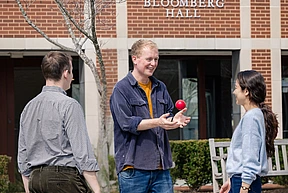
Andy Mummery, John N. Bahcall Fellow (2025–30) in the School of Natural Sciences, might have had the talent for professional cricket, but fortunately for the field of astrophysics, he didn’t quite have the attention span. During his IAS Membership, he is applying his "wandering curiosity" to understanding tidal disruption events, all while preparing for an impending explosion of new data.

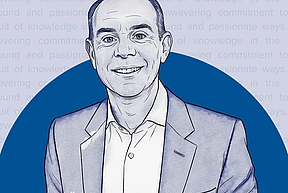
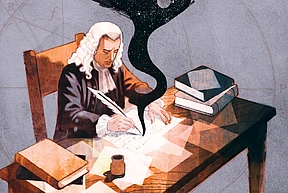
After thirty-five years of studying Isaac Newton, Govind Menon, Erik Ellentuck Fellow (2025–26) in the School of Mathematics, found himself "unlearning" the famous physicist's work. Alongside Akshay Venkatesh, Robert and Luisa Fernholz Professor in the School, he co-led an unusual seminar that invited scholars to encounter historical mathematicians as "kindred spirits," revitalizing the humanistic roots of their discipline.