A History of Reading and Writing the Body
“Come up with an improvisation that uses light weight and quick speed with a bound movement flow,” Whitney Laemmli, Member (2021–22) in the School of Historical Studies, might have been instructed during her years of formal training in dance. Laemmli didn’t recognize this language as the legacy of the Austro-Hungarian expressionist choreographer Rudolph Laban—who had ties to both utopian artist colonies and fascist performances of “Aryan” identity—until she began work on Making Movement Modern: Science, Politics, and the Body in Motion, a book she published this spring with the University of Chicago Press.
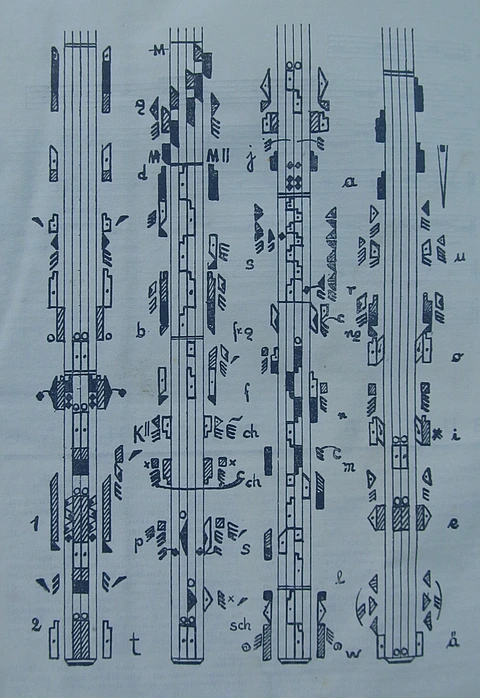
Written during Laemmli’s time at the Institute, Making Movement Modern examines the history of a movement visualization technique called “Labanotation.” Much like musical notation, Labanotation appears glyphic to an untrained eye, simultaneously imaginative and highly systematic. It takes its name from Laban, who, in 1928, imagined a way to transcribe dance and choreography on paper. Over the next nine decades, this system and its permutations would find their way out of dance studios and into factories, hospitals, military training grounds, and robotics labs.
Tracking Labanotation’s strange migration from Weimar-era political rallies to British factory floors and American corporate management, Laemmli’s book illustrates how the quest to chart human movement fundamentally reshaped how we view the body: not just as a vessel of expression, but as a technology to be analyzed, optimized, and controlled.
Dance as Social and Spiritual Tool
Parallel to the strange paths the system took after its publication, Laban and Labanotation emerged out of a confluence of sociocultural forces as revealing as they are complex.
Born in 1879, Laban grew up the son of the military governor of Bosnia-Herzegovina and spent his youth at outposts and then military school before rejecting martial movement for artistic movement. Thus began what the book describes as “the distinctive intertwining of the romantic and modern, the artistic and militaristic, that undergirded both Laban’s life and [Labanotation’s] creation.”
The following decades saw Labanotation—and the desire to master human movement it represented—shapeshift across borders and vocations. Soon after the notation system’s publication in Weimar Germany, Laban and his new technique were commissioned for use in “movement choirs,” a practice in which dozens or hundreds of participants were taught a sequence of motion to be performed in concert. In the German artistic scene of the early twentieth century, new forms of physical exploration (like eurhythmics, bodybuilding, and gestural theater) and cultural phenomena (like cabarets) were flourishing. Premised on unity and collective feeling through simultaneous movement, these choirs made Labanotation into a tool for “stirring the spirit on a mass scale.” When, after 1933, all such choirs came under control of the state, their aims—molded by Nazi ideals—became about solidifying a racialized national identity.
When Laban emigrated to England in 1937, his ideas about transcribing movement came with him. However, instead of charting the bodies of dancers, Labanotation was poised as the solution to another kind of body: that of the industrial worker. There, Laemmli describes, the “notation went from a tool for fortifying German national identity to a mediator of British working life.”
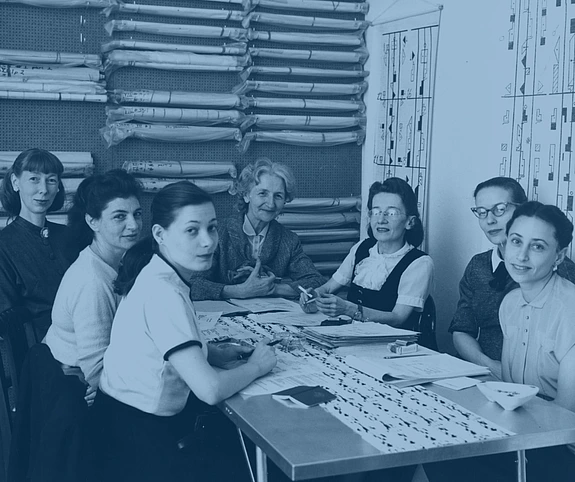
When it arrived in the United States via the Dance Notation Bureau (DNB), a New York-based organization that aimed to popularize Laban’s system, the original philosophical and nationalistic goals of the notation were stripped away. The DNB wanted to turn the fluid, subjective art of dance into pure, objective data. By writing a dance down in standardized symbols, a choreographer in New York could, in theory, send a score to a ballet company in London, and the dancers could recreate the dance’s exact movements without ever seeing the original creation. Labanotation’s journey across the Atlantic also saw the creation of a new kind of worker, the (overwhelmingly female) dance notator—and a collision between human movement and the information age’s preoccupation with data.
Fittingly, this link found its way into the postwar corporate world, in the form of management consulting: the emerging concept of “body language” and Laban-inspired supervision of movement were ideologically joined to sell a system that purported to read and analyze individuals’ physical habits. Employees’ bodies (more specifically, their “movement profiles”) held the key, so the theory went, to their professional abilities and dispositions.
At the same time, Laban-derived methods were applied to access truths about what were considered atypical or dysregulated bodies—those of psychiatric patients, war veterans, and trauma victims. This would become “movement therapy,” an incipient field animated by anxieties about how such pathologized bodies might “incubate” negative emotions and experiences.
Making Movement Modern outlines, finally, the adoption of the technique by folklorists and anthropologists—especially a project helmed by Alan Lomax1 titled “Choreometrics”—that aspired to observe, document, and preserve the whole of dance traditions across the globe. This endeavor had both archival and “activist” ambitions, locating in dance fundamental information about culture and identity.

Towards a Universal Dance
Why was Laban—an experimental artist ostensibly attracted to the special authenticity of dance—so interested in rendering “the four-dimensional fleshiness of the moving body” in print, ossifying it into “something written, replicable, and universally valid”?
For one, Laban was preoccupied with affording dance—in particular, the new modernist forms of dance that interested him— a certain authority and permanence. Through Labanotation, dance, formerly ephemeral and dependent on a live audience, could be preserved over time, a form of knowledge like the written word. And all genres of dance would share a common vocabulary. In addition, Laban hoped, dance would become legible to institutions like universities. If human movement could be laid out and examined, it would become something comparable, replicable, able to be studied—something scientific.
“It’s been interesting working on this project,” says Laemmli, “because on the one hand, I have a lot of critiques of what the effort to capture movement on paper entails and its attendant losses and oversights.”
“On the other hand, movement, and dance in particular, is often feminized, racialized, and not taken seriously, and so, I also understand the desire to make movement legible and thus respectable in some way.”
Another motive was Laban’s belief in a connection between movement and the mind and soul. This idea wasn’t Laban’s alone: early twentieth-century psychologists and theorists increasingly suggested that physical movement and experience could shape human cognition. Controlling movement, and thus bodies, seemed a way to influence the human spirit, too. A system that prescribed movement uniformly would ensure, Laban theorized, that people would experience the right kinds of emotions, at the right time, in the right setting. This control was, for Laban, about building a community—more specifically, one in which members could feel joy, belonging, or recognition, but in a managed or prescribed way.
“I think part of what makes Laban appealing to so many people,” explains Laemmli, “is the way he takes this desire for free-form expression, individuality, and human connectedness, and tries to control it from above. [He is] basically saying, ‘you can have your cake and eat it too.’”
Laemmli points out that there is a discourse on dance—particularly modern dance—that casts it as an especially liberated form of movement. But all genres of dance have rules for the bodies of their performers, and organic-seeming motion is often part of a given style or choreography.
For Laban and his followers, the essence of a given dance was in the choreography, not any one dancer’s interpretation of it. In this way, they saw dance as both universal and universalizing—it transcended the bodies of individual performers and had the power to unite those bodies.

The Politics of Movement Recording
Laemmli arrived at the questions that inspired her work early, and outside of academia: she was trained in ballet through college. “I came into graduate school very interested in the history of the body. I’m a dancer myself. It’s something that I want to be preserved,” she says.
“I don’t think the effort to preserve and communicate movement is in itself problematic. I think the problems arise when the people who use it […] believe in its absolute objectivity, or that nothing will be lost in its capture.”
Historians of science are frequently concerned with the term technology, especially what fits within it. The discipline has, in the last several decades, “moved from thinking about technology as […] large machines that go clank” to “anything that organizes realms of human endeavor,” says Laemmli. Bureaucratic systems like the U.S. electoral college are technology; the cotton gin and the highway are technology; indeed all “ways of doing things that are in some sense codified” fit the definition. And as a “technology like any other,” Labanotation and Laban-based systems have “certain affordances, and certain flaws, and also certain politics.” For Laemmli, keeping these politics in mind is the crucial thing.
“There are people working in dance, disability arts, and other forms of notation now who are interested in how we might use multiple modes of recording at the same time to highlight each system’s particular strengths and weaknesses.” These initiatives are even more important in the context of the other, less critically informed ways in which movement recording is being used today, such as computer-generated animations based on limited, Western movement repertories. Making Movement Modern’s epilogue addresses these modern versions of movement capture and control directly. And, as Laemmli writes, taking movement seriously also means recognizing the ways in which it can be used for both good and ill—how ecstatic forms of embodiment have also functioned as tools of social control.

Bodies, Bodies, Bodies
Laemmli is not yet finished with the physical body and our epistemic relationship to it. Her next project is likely to be a history of scientific and cultural “ideas about emotion and memory as embodied,” especially “embodied in places other than the brain.” The Body Keeps the Score by Bessel van der Kolk, which popularized the notion of trauma being “stored” in the body, is one instance in this history. But there are other figures Laemmli hopes to investigate: American biologist and animal psychologist James McConnell, for instance, who hypothesized a chemical basis for memory based on evidence gathered from so-called “cannibal worms.”
Though the project is “still incipient,” Laemmli knows her overarching research questions. How have people understood how the body is impacted by the world around it? What does the body retain that the mind is or is not aware of? And how and why has it felt important to study these phenomena?
For Making Movement Modern and this upcoming research both, Laemmli describes taking inspiration from sound studies, a highly interdisciplinary field concerned with the politics and history of “sound” as a concept. Crucially, scholars of sound center that which we might take for granted—listening, noise, and the like—and treat it as a site of academic inquiry. For thinkers across anthropology, architecture, science, history, and musicology, sound has become something worthy of theoretical and analytic study. “Sound studies have shown us how much really interesting work can arise when you turn your attention to a new object,” Laemmli enthuses.
Movement as an object is young as far as academic studies go. Laemmli expects this to change: “Everyone has a body.” And the moving human body, at turns problematic, manipulable, expressive, and utilitarian, is shaped by tides of power and history—just as the historical record is shaped by bodies in motion.
[1] Alan Lomax (1915–2002) was an American folklorist, archivist, activist, oral historian, and ethnomusicologist best known for his work collecting field recordings of folk and blues traditions in the U.S. and Europe.