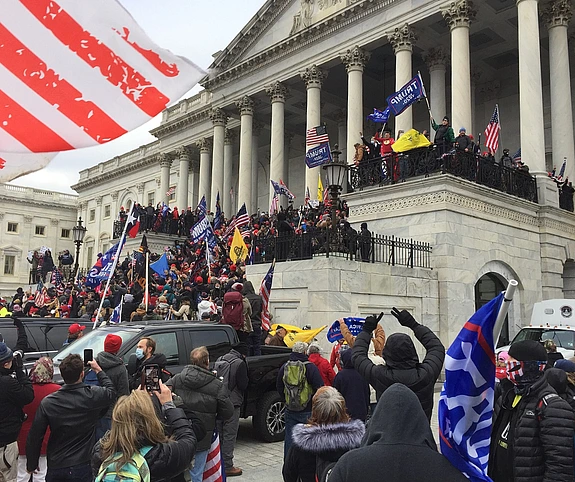
In Paranoid Publics: Psychopolitics of Truth, Zahid R. Chaudhary, Member (2023–24) in the School of Social Science, brings psychoanalysis to bear on modern culture’s fraught relationship to truth. Chaudhary contends that turning to psychodynamics—namely, the dynamic interplay of desires, compulsions, and the like that motivate individual and collective behavior—can help to unravel “the erosion of what we once took for granted” about truth and facts. Written during Chaudhary’s time at the Institute, the book uses thinkers such as Freud, Adorno, and especially Foucault, to examine case studies including election denialism, public health resistance, and the far-right conspiracy theory QAnon.
As Chaudhary sees it, the agreed-upon story about these phenomena among liberals, that attachments to so-called “unreality” arise from political-economic reality, is too simplistic. According to this narrative, increasing inequality and the unfulfilled promise of upward mobility have produced a widespread sense of abandonment among the under-resourced majority, whose anger is then mutated by increasingly myopic and narrow media channels (for example, our ever-personalizing and inflammatory social media algorithms).
Paranoid Publics offers an alternative; that unconscious mental forces like our fears and memories might also inform attitudes about truth, and that the unconscious plays a role in political-economic processes. When wealthy, liberal women subscribers of Gwyneth Paltrow’s lifestyle brand “Goop” and insurrection enthusiasts who follow Alex Jones purchase the same pseudo “health supplement,” albeit under different names, Chaudhary identifies that the divergent groups of consumers are united by the same paranoid fantasy about a hostile external world. “Both companies offer their consumers psychic release conditioned on a notion of the body as a fortress under threat,” he writes.
Rather than dismissing these collective forms of paranoia as mere delusion, Chaudhary challenges readers to ask whether they might “illuminate the social realities that give rise to them”—offering a new framework for understanding our fractured political landscape.