News

Explore the latest news related to the Institute for Advanced Study and its community of scholars.

The Institute welcomes inquiries from the press regarding coverage of the Institute and its scholars, interviews, and filming. Please direct all inquiries to Lee Sandberg at lsandberg@ias.edu.
Type:

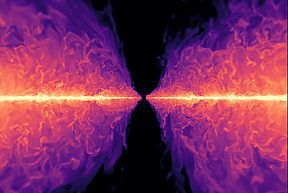
Building on decades of effort, Lizhong Zhang, Member (2023–24) in the School of Natural Sciences; James Stone, Professor in the School; and a team of astrophysicists have achieved a major milestone: developing the most comprehensive model to date of luminous black hole accretion. Their breakthrough allows scholars to "observe" such black hole systems not through a telescope, but through a computer.

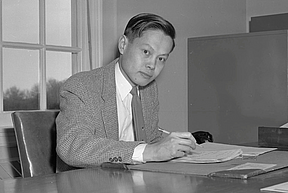
Chen Ning Yang (杨振宁), Faculty (1955–66) and Member (1949–54) in the Institute for Advanced Study’s School of Mathematics/Natural Sciences, passed away on October 18, 2025 at the age of 103. At the Institute, he produced a body of work which redefined how scientists conceptualize the fundamental symmetries of the universe. 

On September 22, the Institute officially began its 2025–26 academic year, bringing together scholars from around the globe to pursue a range of individual and collaborative projects. The 259 visiting scholars, representing 39 nations and more than 108 institutions, will work alongside the 26 permanent Faculty and 22 Emeriti, all of whom are leaders in their respective fields.

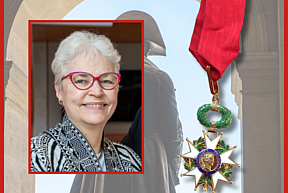
Victoria B. Bjorklund, IAS Trustee since 2006, will be presented with the insignia of Knight of the Légion d’Honneur, France’s most prestigious decoration, on September 10, 2025. The honor recognizes Bjorklund’s extraordinary commitment to building French-American ties through philanthropy and her remarkable service to French nonprofit initiatives.

In an article for Nature, Ananyo Bhattacharya, science writer at the London Institute for Mathematical Sciences and biographer of John von Neumann, founding Professor (1933–55) in the School of Mathematics, lays out the significance of a "major advance" in research into the Langlands program—the "grand unified theory of mathematics" first laid out by Robert Langlands, Professor Emeritus in the School.

Renowned papyrologist Sofía Torallas Tovar from the School of Historical Studies has opened a new exhibition exploring the history and influence of Ezekiel’s Papyrus at the National Library of Spain. The exhibition invites visitors to view both original pages of the papyrus and digital recreations of the text in a journey that traverses both centuries and civilizations.

Does artificial intelligence have a role to play in pure mathematics—the kind of math still worked out on blackboards over decades? To interrogate this question, The New York Times spoke to IAS scholars from diverse disciplinary perspectives: Members Patrick Shafto (2021–23) and Andrew Granville (1989–91, 2007, 2009–10) in the School of Mathematics, and Alondra Nelson, Harold F. Linder Professor in the School of Social Science.

The Max Planck-IAS-NTU Center (MPC) for Particle Physics, Cosmology, and Geometry is a new global research center established to better understand the universe at all scales. The collaborative initiative will be led by Co-Directors Nima Arkani-Hamed, Gopal Prasad Professor in the School of Natural Sciences, Johannes Henn (MPP), and Daniel Baumann (NTU), both past Members in the School.

The Institute for Advanced Study is creating a new professorship in the theory of computing, supported by a gift from John Overdeck, the chair of the Institute’s Board of Trustees. The Betsey Lombard Overdeck Theory of Computing Professorship, in the Institute’s School of Mathematics, will be held by Irit Dveer Dinur, a preeminent theorist in computational complexity.

A small team led by Sihao Cheng, Martin A. and Helen Chooljian Member in the School of Natural Sciences, has discovered an extraordinary trans-Neptunian object (TNO) at the edge of our solar system. The TNO is potentially large enough to qualify as a dwarf planet, the same category as the much more well-known Pluto. The discovery has significant implications for our understanding of the Kuiper Belt and hypotheses that surround the existence of Planet Nine.

The Institute’s Communications team welcomes inquiries from the press regarding coverage of the Institute and its scholars, interviews, and filming. For information about the Institute and current research, visit About and the Ideas sections of the website.

Please direct all public relations inquiries to Lee Sandberg at lsandberg@ias.edu.