IAS Scholars on Walking the Institute
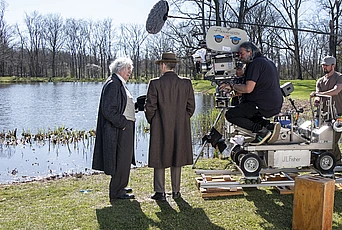
Albert Einstein, founding Faculty (1933–55) in the School of Mathematics/Natural Sciences, is often quoted as saying that he came to the Institute campus for a single, cherished purpose: the pleasure of walking home with Kurt Gödel. Gödel, Einstein’s colleague and fellow wanderer, was associated with the Institute from his first visit in 1933–34 until his death in 1978.
This tradition of thoughtful ambling—what Director and Leon Levy Professor David Nirenberg calls “peripatetic cogitation”—continues to shape life at IAS.
In his welcome address to the Institute community at the start of the 2025–26 academic year, Nirenberg also invoked the Institute’s surroundings—its fields, forests, and meadows—as spaces deliberately designed not simply for work, but for reflection, encounter, and the cultivation of ideas. Here, among the “fractal leafiness and winding paths,” scholars are invited to step away from the world’s relentless utility and urgency, finding in the hush of the Woods the freedom to think, converse, and discover.
This installment of the Campus Conversation series features reflections from Members and Visitors across all four IAS Schools, highlighting how the simple act of walking—alone or in conversation—continues to animate the Institute community, echoing the footsteps of Einstein and Gödel along paths both familiar and new.
"Visitors to the Institute often remark on how fortunate I am to enjoy such a generous office. Whilst this is true, I am always quick to suggest that we continue our conversations outside. The turtle-filled pond and wandering woodland paths offer a unique mindfulness. The pacing of feet paces conversation and guides it along unexplored directions—especially with a cuppa in hand!
In spring, as the pond thawed and turtles emerged from their wintry brumation, my collaborator and I filled our mugs and took a daily stroll around the water. During our own orbital circuits, we discussed planets embedded in gaseous disks, orbiting their star. The wake of ducks atop the pond is not too dissimilar to the waves launched by these planets. This resonance of ideas, forged by people and place, yielded novel results. I think I’ll continue orbiting the pond and see what the next year brings."
Callum W. Fairbairn
Friends of the Institute for Advanced Study Member (2023–26), School of Natural Sciences
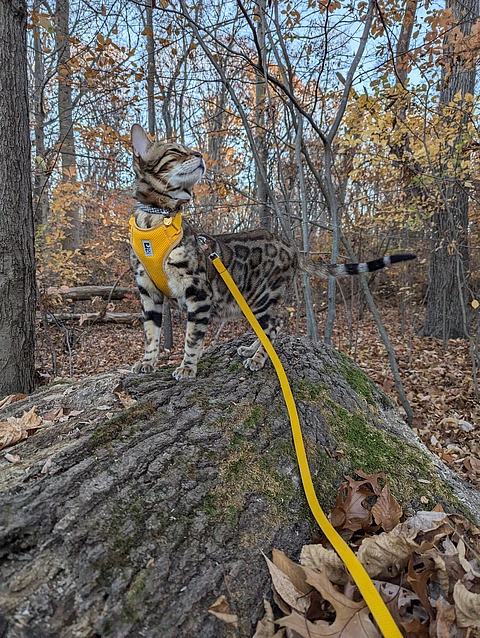
"One of the great privileges of life at the Institute is the opportunity, in those moments when one is stuck, with incomplete sentences swirling around the head, to pause, shut one’s laptop, and take a walk. This could mean a short stroll from the library to Fuld Hall, a loop around the pond, or, if feeling ambitious, a longer trek through the Institute Woods (in my case, typically accompanied by my intrepid cat). I can’t say that I ever had an epiphany while underway in the woods, but these walks did exactly what I needed them to do—they offered a space to breathe, clear the head, and momentarily get lost in another rhythm before heading back, sitting down again, and getting back into the flow of writing. There’s no better cure for writer’s block!"
Katerina Korola
Member (2024), School of Historical Studies
"One of my favorite parts of being at IAS is its close proximity to nature. In just a short walk through the woods and around the lake, I can see many different animals: deer, foxes, rabbits, frogs, herons, snakes, and, of course, fish. My work involves making connections between spectral algorithms and problems in coding theory, extremal combinatorics, and cryptography, which require ingenuity to explore, and I find that walking is a great way to clear my head when I’m stuck on a research problem!"
Peter Manohar
Member (2024–26), School of Mathematics
"Walking on the Institute’s paths to lunch and afternoon tea has led to many wonderful conversations, including one with sociologist R. L’Heureux Lewis-McCoy [Member (2024–25) in the School of Social Science] after he gave a seminar titled ‘The Afterlives of Integration.’ L’Heureux used the term ‘muting’ to characterize voices within minoritized communities sounding in majority spaces. To musicians and musicologists such as myself, ‘muting’ has many meanings beyond the familiar act of muting during an online meeting. A muted sound varies considerably depending on the type of instrument (e.g., violin, trumpet, saxophone) and type of mute (wood, fiber, metal, rubber). Our lively chat led to me sharing recorded sounds of muted instruments and my essay on the last movement of Ruth Crawford’s String Quartet 1931, in which three instruments play sempre con sordino (always with mute). That walking conversation impacted L’Heureux’s articulation of the term in the published version of his paper."
Ellie M. Hisama
Edward T. Cone Member in Music Studies (2024), School of Historical Studies
Visitor (2025), School of Social Science
"We lived at the edge of the campus and took some fifteen minutes to walk to West Building, home of the School of Social Science. It was a perfect time to discuss my work with Leszek [Koczanowicz, Member (2024–25) in the School]. I still remember seeing a spreading tree at the pond on my very first day. It stood out, monumental and the first to turn fall colors. I liked these walks and the changing scenery; they became more than just passage. The harmony of movements, breath, and landscape bespeaks the oneness of the human and nature. My project concerned visualizing and embodying the climate crisis in art. Many artists agree that by disrupting this balance, we destroy the environment and wreck the basis of our existence. Hence, we must cultivate our bond with nature today—not as sentimental wistfulness, but as a practice of care to protect the future."
Dorota Koczanowicz
Visitor (2024–25), School of Social Science
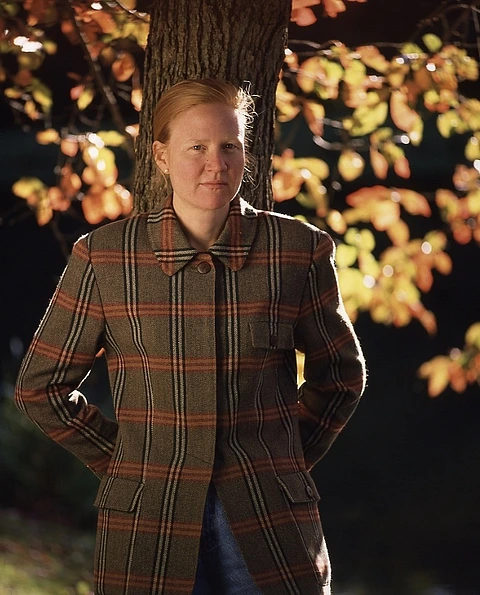
"With its canopy of trees and wildflowers, the wooded floodplain surrounding the Institute is a special place. Treasured in the 1930’s as the world’s first think tank, Oswald Veblen, founding Professor (1932–60) in the School of Mathematics, carved serpentining paths throughout the Woods, and Abraham Flexner, Director (1930–39), strived to create a bucolic setting for his ‘society of scholars.’
I have always needed to move. My office overlooked the pond and the tall tupelo trees that turned scarlet overnight lured me into the landscape. And as I walked—usually alone—I would give thanks to the founders, pondering whether their quiet hours spent in the natural world were a source of inspiration or perhaps a tonic for the unspeakable experienced in war torn Europe? Possibly a bit of both.”
Barbara Paca
Visitor (1996–97), School of Historical Studies
President, Association of Members of the Institute for Advanced Study (AMIAS) Board of Trustees
"Anecdotally, I’ve found that scientists tend to be very outdoorsy. We love to hike, cycle, run, and climb. For the most part, I think this tendency comes from a desire to balance the unpredictable yield of scientific pursuit with the predictable, quantifiable yield of, say, training for a marathon. Yet, as much as I enjoy outdoor recreation as a means to challenge myself, my time at IAS helped me remember the immeasurable value of simply existing in nature.
The Institute Woods are relatively small. The terrain isn’t steep or otherwise challenging. Instead, the Woods invite you to stroll, to chat with a colleague, or to simply sit and admire the canopy. Sometimes, that meditative quality had a practical benefit; I would often go for a walk whenever I struggled to debug the codes I use to simulate astrophysical shocks and model particle acceleration. But, most of the time, I wandered into the woods simply to enjoy the peace they offered."
Rebecca Rimai Diesing
Ralph E. and Doris M. Hansmann Member (2023–25), School of Natural Sciences
"To walk is to take a risk. When one walks, one must be open to untimely encounters with others, encounters that may even cross the species divide. For example, during a walk in the woods at IAS, one might expose oneself to ticks and, more broadly, to other possible contaminations. Yet it is in these possible encounters, unsettling as they might be, that the greatest learning also takes place, because one must be open to worlds that cannot be cordoned away (although the security apparatuses we build continue to pursue that latter goal).
At IAS, it was while walking that I learned most, from friends and strangers, human and animal. This required opening myself disciplinarily, theoretically, and personally to difficult conversations and unexpected meetings, to expose myself to a series of unknowns that continue to enrich my thinking. I am grateful for that walking, for those risks, for the Institute."
Rajbir Judge
AMIAS Member (2024–25), School of Social Science