The Breakthrough Proof Bringing Mathematics Closer to a Grand Unified Theory
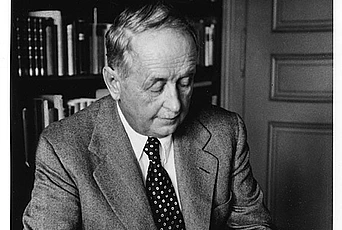
In an article for Nature, Ananyo Bhattacharya, science writer at the London Institute for Mathematical Sciences and biographer of John von Neumann, founding Professor (1933–55) in the School of Mathematics, lays out the significance of a “major advance” in research into the Langlands program.
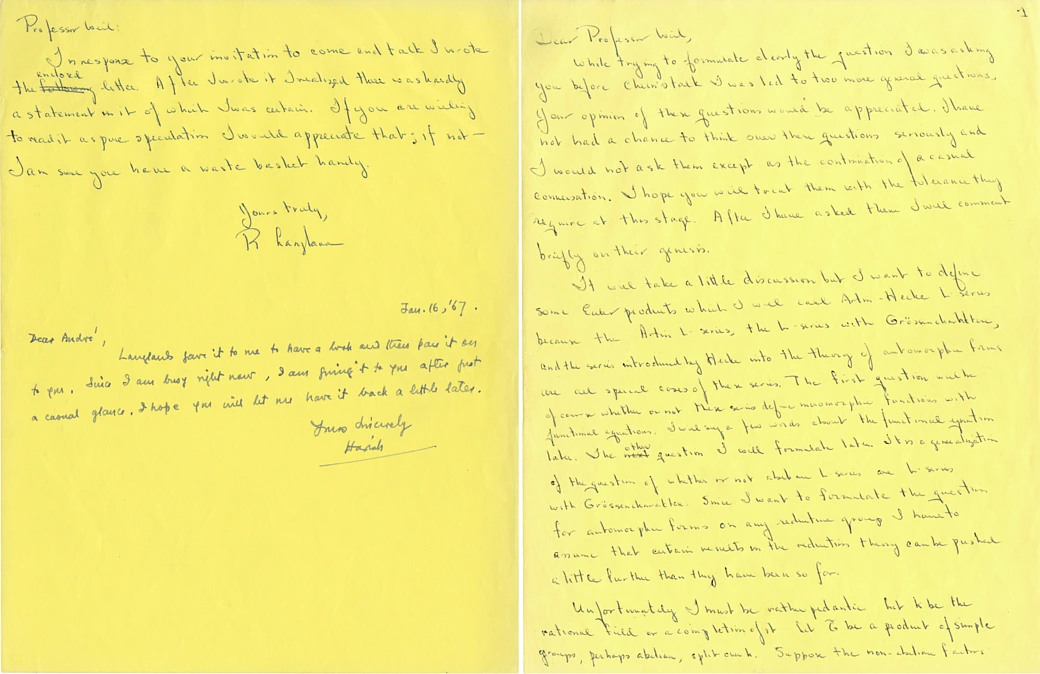
For more than half a century, the Langlands program, first laid out by Robert Langlands, Professor Emeritus in the School of Mathematics, in a handwritten letter to André Weil, Professor (1958–98) in the School, has captivated mathematicians with its promise of providing a “grand unified theory of mathematics.” The program originally sought to make deep connections between number theory and harmonic analysis.
Last year, a team led by Dennis Gaitsgory, Member (1996–97, 1998–99) in the School, and Sam Raskin of Yale University unveiled a Breakthrough Prize-winning proof of the geometric Langlands conjecture, first developed by frequent Member Vladimir Drinfeld in the 1980s.
“Like the original or arithmetic form of the Langlands conjecture, the geometric conjecture also makes a type of connection: it suggests a correspondence between two different sets of mathematical objects … Both concern properties of Riemann surfaces, which are ‘complex manifolds’—structures with coordinates that are complex numbers (with real and imaginary parts). These manifolds can take the form of spheres, doughnuts, or pretzel-like shapes with two or more holes.”
Gatisgory and Raskin’s proof, spanning nearly 1,000 pages across five papers, has been hailed by David Ben-Zvi, Member (2008, 2018) in the School of Mathematics, as a “huge triumph.” But rather than closing the book on the subject, it opens up new avenues for research.
The geometric Langlands conjecture also builds bridges to other fields, including quantum physics. In this area, Edward Witten, Professor Emeritus in the School of Natural Sciences, and Anton Kapustin, Member (1997–2001) in the School, have shown that “a class of theories that includes the standard model of particle physics possesses the same symmetry that appears in the geometric Langlands correspondence.” This suggests profound ties between mathematics and the fundamental laws of nature.
Now, Ben-Zvi, alongside Yiannis Sakellaridis, Member (2011) and von Neumann Fellow (2017–18) in the School of Mathematics, and Akshay Venkatesh, Robert & Luisa Fernholz Professor in the School, is “similarly seeking inspiration from theoretical physics, with a sweeping project that seeks to reimagine the whole Langlands program from the perspective of gauge theory.”
Gaitsgory is also building on this new proof. Working with Jessica Fintzen, Member (2017–18, 2020–21) in the School of Mathematics, among others, he is extending his analysis “to the local geometric Langlands conjecture to understand in more detail what happens around a single point.”
The Langlands program remains a nexus of ideas, promising to shape mathematics—and its connections to physics—for years to come.
Read the full article at Nature.