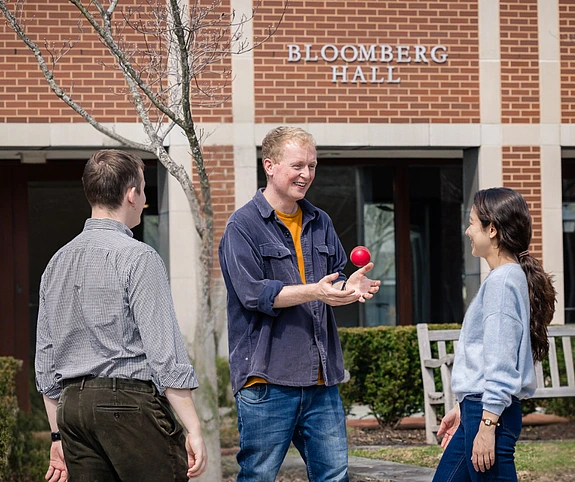
Andy Mummery might have had the talent for professional cricket, but fortunately for the field of astrophysics, he didn’t quite have the attention span.
“I got too distracted,” he says. “I’d wander off or get bored and try something new, which doesn’t work all that well if you’re trying to perfect a technique or, you know, catch a ball.”
This wandering curiosity, however, is precisely what makes him an excellent scientist, and, in particular, a scientist who has been able to seize all of the opportunities that an IAS Membership has to offer.
Since arriving at the Institute, the John N. Bahcall Fellow (2025–30) in the School of Natural Sciences has not only been awarded two major grants to use the Hubble and James Webb space telescopes to study his astrophysical phenomena of choice, tidal disruption events, but has also branched out into an entirely new area, namely galactic dynamics.
It is a fittingly expansive portfolio for a researcher who admits he has never been interested in small, fundamental scales. “I am just excited by big things generally,” he says.
Yet, while Mummery is drawn to the massive lengthscale of the cosmos, the primary focus of his research— tidal disruption events, or TDEs— are unique precisely because they occur on a distinctly shorter timescale than is usual for astrophysical phenomena.
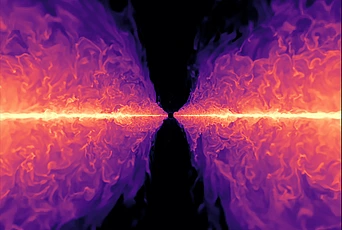
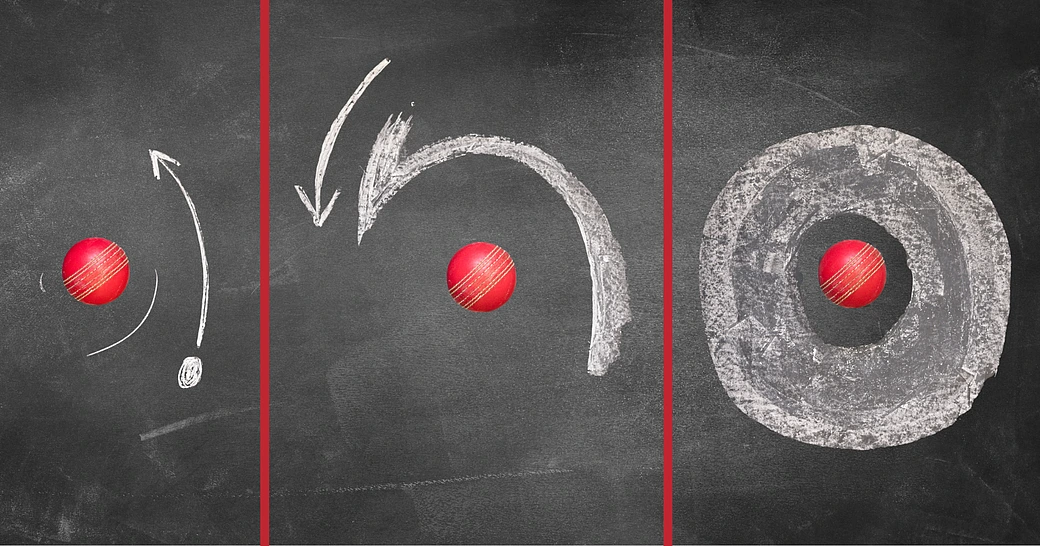
A tidal disruption event happens when a star wanders too close to a black hole and gets ripped apart. The shredded star creates an accretion disk of swirling gas moving at extremely high speeds around the black hole. The disk produces a bright flare of light that briefly lights up a formerly dark region of space. While typical supermassive black holes evolve over millions of years—a timeframe Mummery jokingly describes as “not as interesting, because I’m not going to live a million years!”—a TDE shreds a star in about a day, and the resulting luminosity from this process evolves over a period of just months or years. For Mummery, this provides a rare, fleeting window to watch the universe’s largest objects actively change within a human lifetime.
TDEs also map onto Mummery’s own path through spacetime—the field is effectively the same age as he is—and their scientific appeal is therefore deeply personal. While TDEs as a phenomenon were predicted by theorists in the 1970s, the first class of TDEs was discovered by X-ray telescopes in the 1990s. Mummery himself was born in 1996. In fact, he can literally mark his own date of birth on their luminosity charts.
Since those early days, his coming-of-age as a scientist has mirrored the field’s technological explosion. “It’s a quirk of when I was born and when the optical surveys took place,” he says. “I started my Ph.D. in 2018 when there were fewer than ten known TDEs. We’re now at maybe 100 to 200, depending on who you ask. But by the end of my time here at IAS, we should have thousands. There’s only one time that this exponential growth in data will happen and being around that is very exciting.”
The primary engine driving this incoming explosion of data is the Legacy Survey of Space and Time (LSST), recently switched on at the Vera C. Rubin Observatory in Chile. For Mummery, the sheer volume of information the LSST is poised to capture is staggering. “They’re expecting to find one TDE an hour for a decade, which is about 80,000 to 100,000, a huge increase in data,” he says. However, this deluge of data brings its own immediate challenges.
“On the first night they switched it on, I think there were about 50,000 alerts of ‘something’s gone flash in the sky!’” he says. “Loads of them are asteroids. Loads of them are supernovae. There’s about one TDE in a galaxy for every 100 supernovae. So it becomes a problem of, sure, the telescope will have seen one TDE an hour, but can I pick it out of this monstrous stream of other data?”
Locating a TDE is what Mummery calls a classic “needle in a haystack” problem, one that he describes himself as “pleased that I don’t have to work on!” Happily, other scientists are actively trying to filter the data using machine learning. If they can successfully sift through the noise, the scientific payoff will be revolutionary. Identifying tens of thousands of TDEs might finally allow astrophysicists to answer fundamental questions about the demographics and evolution of black holes.
Currently, scholars know about relatively small stellar-mass black holes in our galaxy, which are tens of times the mass of the sun, and the supermassive giants at the centers of galaxies, which start at around a million solar masses. But as Mummery explains, there is a glaring, unexplained gap in the middle.
“It’s like if you looked around at people and you saw babies and adults, you would guess that there were children and teenagers in between, but we don’t seem very good at finding them,” he says.
TDEs are currently the best way to probe for these hidden “intermediate-mass” black holes.
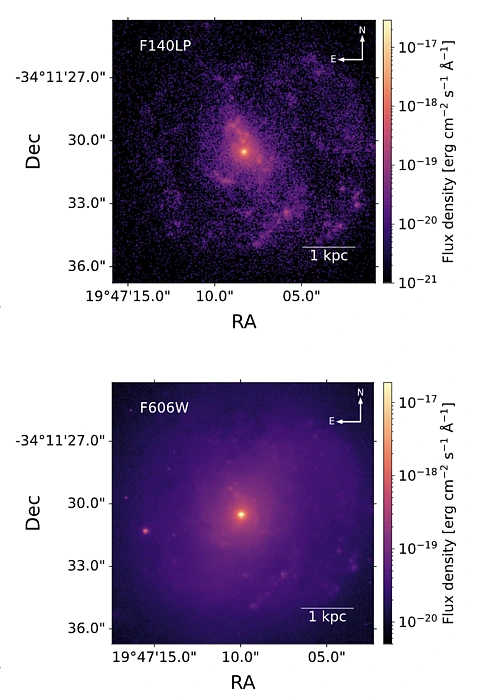
by Mummery and his colleagues indicated that GSN069 hosts a compact, viscously expanding accretion disk likely formed after a TDE.
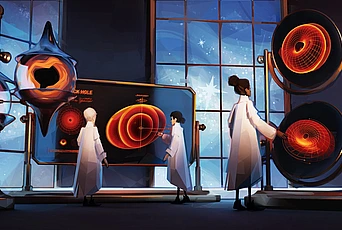
But how can you tell how massive a black hole is from a TDE? That’s where Mummery comes in. His process starts with a fixed set of observational data gathered by telescopes, which record exactly how bright a TDE flare was on specific days across various wavelengths of light, including red, blue, UV, and X-ray. Mummery then uses his pen-and-paper models to make predictions based on variable parameters, calculating how bright the flare should have been on those specific days for a black hole of a certain size. Using sophisticated statistical frameworks, such as Bayesian and Markov Chain Monte Carlo (MCMC) methods, he identifies the differences between his theoretical model and the real-world data. By tweaking the theoretical parameters to make that difference as small as possible, Mummery finds the model that draws a line closest to the observed data points, thereby revealing the mass of the black hole.
If, using these methods, Mummery can use the new data from LSST to map out a continuous spectrum of black hole sizes, it will finally reveal the evolutionary links between the “baby” black holes and the “adults”—perhaps solving the mystery of how supermassive black holes formed in the early universe. “And that’s why we should care about TDEs,” he says.
But Mummery isn’t going to stop there. He is also using different instruments, highly targeted observations using the Hubble and James Webb space telescopes, to answer other lingering questions about how TDEs operate.
For a long time, scientists expected a TDE to flare and fade within about a year. However, through their theoretical accretion disk models, Mummery and his colleagues realized that the shredded stellar material struggles to lose its angular momentum, causing the glowing disk to persist much longer than was initially thought. To find out exactly how long they stick around, they were awarded time on the Hubble Space Telescope to check in on the class of TDEs discovered by X-ray telescopes in the 1990s. Because the question is a simple binary—is the disk still glowing 30 years later, yes or no?—the telescope only needs to take a picture.
Meanwhile, his time on the James Webb Space Telescope is dedicated to a different mystery: TDE candidates that appear to flash from the middle of nowhere. For a TDE to occur, a black hole needs a star to rip apart, meaning there should be a cluster of stars present. Yet, with some intermediate-mass black hole candidates, current instruments see nothing but a massive flash seemingly coming “just from the vacuum of space,” explains Mummery.
He suspects that these black holes might just be surrounded by a very small number of faint stars, which he hopes James Webb’s highly sensitive instruments will finally be able to detect.
“But if the flashes really are coming from the vacuum of space, then it’s an even bigger mystery,” he notes. For Mummery, coming up empty-handed would be just as thrilling as finding the missing stars. “Whatever we see, it’ll be an interesting answer,” he says.
Finding interesting answers to complex astronomical problems is exactly what prompted Mummery to branch out into a completely different area of astrophysics during his time at IAS: galactic dynamics.
The shift came about through a new collaboration with his IAS colleague Chris Hamilton, also a John N. Bahcall Fellow (2021–26) in the School of Natural Sciences. As Mummery tells it, “Chris and I are from a similar part of the world. We’ve been educated at similar places, come from all the same groups, but somehow never really bumped into each other much before I came here.”
They quickly bonded over a shared scientific philosophy. Like Mummery, Hamilton is a theorist who prefers to tackle complex astrophysical problems, in Mummery’s words, “carefully and properly, using pen and paper,” rather than relying on massive numerical simulations.
Having seen Mummery successfully build statistical frameworks to fit his theoretical TDE models to telescope observations, Hamilton proposed a collaboration. He wanted to know if Mummery’s toolkit could be applied to the wealth of data that has been gathered by the Gaia Space Telescope. In particular, he was searching for the origin of a famous ripple in the motions of stars around the Milky Way.
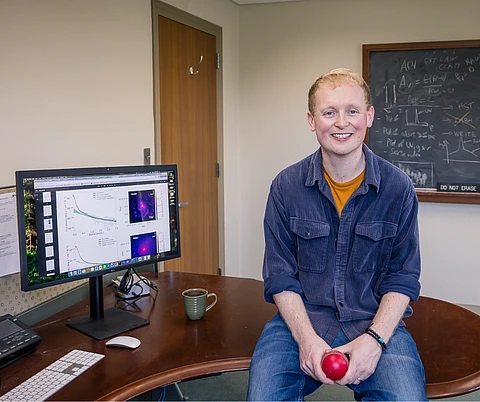
While a shredded star and the massive structure of a galaxy seem entirely unrelated, the two problems share a remarkably similar structure. In both cases there is a signal, a flash of light in Mummery’s case, a galactic ripple in Hamilton’s. And, in both cases, the theorists believe they know roughly what is causing that signal. Mummery’s are the consequence of a star being torn apart, while Hamilton’s hypothesis was that the Milky Way stars were shunted by a large spiral arm of stars and gas a few hundred million years ago, causing the ripple that we still observe today. But neither of them could pin down the precise parameters of their systems of interest. Just as Mummery was working to identify the precise mass (as well as the spin) of the black holes that were crucial to the tidal disruption events, Hamilton needed to identify key parameters for his system, such as how tightly wound the galactic spiral was, how long it lived, and exactly when it perturbed the galaxy.
Mummery helped Hamilton to formulate his problem in such a way that the same statistical toolkit used to explore TDEs could be applied to the galactic question. The statistical framework they employed allowed them to search over large numbers of possibilities and find the one that fit the data best.
The result? The pair, who conducted their study alongside Joss Bland-Hawthorn of the Sydney Institute for Astronomy, concluded that short-lived spirals, probably with around two arms, perturbed our galaxy around 400 million years ago. This conclusion is an important piece of the puzzle in deducing the history of our galaxy.
Mummery is optimistic about what’s next, especially for TDEs. “I think as a community, we’ve got to a really good point where we understand the basics. We definitely don’t understand everything about these problems, but we don’t understand nothing. And we’re just about to go into the world of big data. And I think we’ve done really well to get ourselves to a point where we can start to exploit this. I think it’s going to be a big few years.”
It is a future that will rely heavily on his unique brand of pen-and-paper theory—which is exactly where he intends to stay. While visiting the new LSST observatory in Chile might sound appealing, he jokes that for everyone’s sake, he should probably stick to the theory. “I hope they wouldn’t let me anywhere near it,” he laughs. “I can do data but I can’t do experiments. You don’t want to be the guy who knocks something over.”
Mummery may never have had the attention span to perfect his wicket-taking technique, but as it turns out, his restless curiosity made him perfectly suited to catch something much more elusive: a black hole lighting up in the dark.