In 1952, mathematician Armand Borel arrived on campus for a two-year stay as a Member at the Institute. Borel, who in 1957 would become Faculty in the School of Mathematics, brought with him his wife, Gabrielle Aline Pittet-Borel. The couple met when Armand was completing graduate work at the ETH Zürich and Gabrielle, a classically trained artist, was drawing weather maps at a meteorological institute. Their two children, Anne and Dominique, grew up in Princeton following Armand’s appointment to the Faculty.
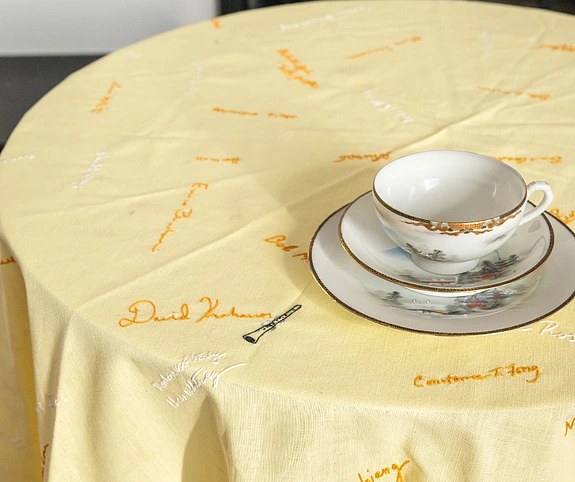
As her oral history—housed in the Institute’s Shelby White and Leon Levy Archives Center—attests, Gabrielle, known locally as Gaby, was a frequent entertainer who enjoyed the company of an eclectic mix of guests. During the family’s time at IAS, she initiated a unique tradition: dinner guests would sign their names on her tablecloth, autographs which Gaby then immortalized by embroidering them onto the fabric. The signatories include well-known figures of the math world, like Member (1956–57; 1961–64) in the School of Mathematics John Nash and Professor Emeritus in the School, Peter Sarnak, alongside other stalwarts of the Institute community, such as Herman Joachim, who still works in the Institute’s mailroom today. With names of those hailing from as far as Ukraine and as close as Orange, New Jersey, the tablecloth represents a truly international group.
The tablecloth, beautifully “of-the-period,” also reflects not only the cosmopolitan nature of the Borels’ personal circles, but that of the larger Institute, too. As an artifact, it attests to the intimacy of an environment that welcomes scholars from across the globe, while hinting at what is perhaps the most ephemeral aspect of the Institute’s legacy: conversation.
Such exchanges can be particularly difficult to capture and preserve for future generations. Fortunately, this textile—generously donated to the Archives Center by Dominique Borel in early 2026— helps to fill one of the largest gaps within the Institute’s historical record. Through its intricate embroidery, the piece embodies the network of dialogue and engagement characteristic of IAS and its unique community.
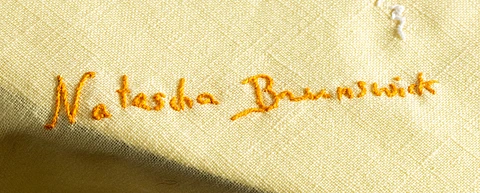
Natascha Artin Brunswick (signed Natascha Brunswick) was born in St. Petersburg in 1909 before her family fled the Russian Empire in the aftermath of the October Revolution. She studied mathematics at the University of Hamburg, where she met and married mathematics professor Emil Artin. During this time, she also pursued a keen interest in the arts and took courses in art history from Erwin Panofsky, Professor (1935–68) in the School of Historical Studies, and Aby Warburg. In 1937, the family fled to the U.S., eventually arriving in Princeton. There, Brunswick worked closely with Richard Courant at New York University and became both the technical editor for its journal Communications on Pure and Applied Mathematics and the translation editor of Theory of Probability and its Applications. The Artins divorced in 1958, but Brunswick remained in Princeton and remained dedicated to her mathematical work, which she continued until her retirement in 1989. Today, she is remembered for both her mathematics and her artwork.
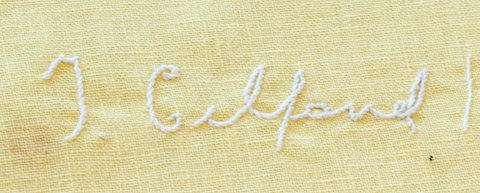
Israel Moiseevich Gelfand (signed I. Gelfand) was born in Okny, Ukraine in 1913. Gelfand began postgraduate study at Moscow State University at the age of 19 under the mathematician Andrey Kolmogorov and received his Ph.D. in 1935. From 1943 until 1989, Gelfand conducted research at Moscow State University, where he became widely known for his work in group theory, mathematical analysis, and representation theory. Over the course of his career, Gelfand was awarded the Order of Lenin, the Wolf Prize, the Wigner Medal, and the Kyoto Prize. On the eve of his 76th birthday, Gelfand immigrated to the U.S., where he began to give his famed seminars at Rutgers University. Gelfand settled in Highland Park, New Jersey, where he remained in close contact with several IAS mathematicians. He passed away in New Brunswick at the age of 96.
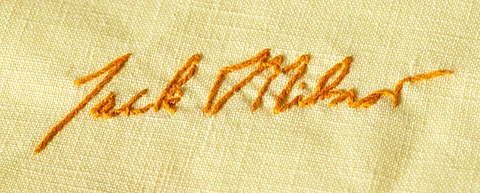
John Willard Milnor (signed Jack Milnor) was born in Orange, New Jersey in 1931. He attended Princeton University as an undergraduate and, at only 19, proved the Fáry-Milnor theorem, setting the stage for a prolific mathematical career. In 1956, two short years after receiving his Ph.D., he proved the existence of 7-dimensional spheres with nonstandard differentiable structure, opening the pathway to the field of differential topology. Milnor worked at Princeton University for several years and, from 1970–90, served on the Faculty of the School of Mathematics. Milnor has been widely lauded for his work: his honors include a Fields Medal, a National Medal of Sciences, a Wolf Prize, and an Abel Prize. His name appears alongside that of his wife, Dusa McDuff.
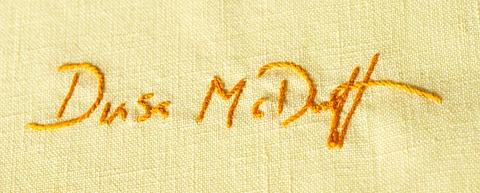
Dusa McDuff was born Margaret Dusa Waddington in London in 1945. She completed her undergraduate studies at the University of Edinburgh before moving to Girton College, Cambridge to study functional analysis under the tutelage of George A. Reid. Later, she taught at the University of York, where she worked with Graeme Segal, Member (1969–70) in the School of Mathematics. In 1976, she joined IAS as a Member, working with Segal on the Atiyah-Segal completion theorem. Around this time, McDuff met John Milnor, who was then based at Princeton University. The two married in 1984. Today, they both continue their research. In 2025, McDuff was awarded the American Mathematical Society’s Leroy P. Steele Prize for Lifetime Achievement.
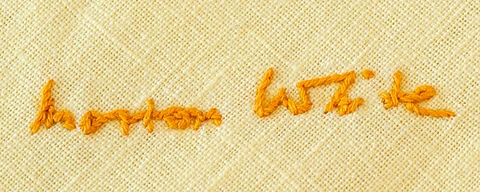
Morton White was born in New York City in 1917. At the age of fifteen, he enrolled in the City College of New York. He received his bachelor’s degree in philosophy, and then went on to obtain a Ph.D. in the subject from Columbia University in 1942. He took on his first position as an Assistant Professor at the University of Pennsylvania in 1946, before moving to Harvard University in 1948. While at Harvard, White visited the Institute as a Member (1953–54; 1962–63; 1968) in the School of Historical Studies. These visits sparked a deep affection in White, who later wrote, “From the moment I first came to the Institute in 1953, I longed to be there forever.” Indeed, he returned as Faculty in 1970. Though White was a philosopher by training, his time at the Institute allowed him to form interdisciplinary ties, including with such Faculty as Kurt Gödel, then-Professor Emeritus in the School of Mathematics.