A balanced convex domain in 𝑅 𝑛 is a compact convex set that is
invariant under the (𝑍/2) 𝑛 action which flips the signs of the
coordinates. In this talk, I will explain a construction of a
simple symplectic embedding of a ball of capacity 4 into...
Using loops of contactomorphisms generated by vector fields that
are positively transverse to the contact distribution, Eliashberg
and Polterovich introduced the notion of orderability for contact
manifolds. Recent work seems to suggest that the...
In 1989, DiPerna and Lions developed a well-posedness theory for
bounded solutions of transport equations driven by Sobolev vector
fields. A related conjecture on mixing efficiency in incompressible
flows was formulated by Bressan in 2003 and...
In recent joint work with Paul Biran and Octav Cornea, we
introduced a notion of approximability for metric spaces whose
points are objects of a triangulated category. This provides a
quantitative analogue of (split-)generation. I will explain
in...
I will discuss the interplay between rigidity and flexibility in
symplectic dynamics, a topic that has fascinated me for much of my
adult life. I understand the situation in
low-dimensions much better, and this will be the focus of my talk,
but I...
The nearby Lagrangian conjecture asks whether every closed exact
Lagrangian in the cotangent bundle of a closed manifold is
Hamiltonian isotopic to the zero section. Although relatively few
results on this conjecture are known, some progress has...
For those who enjoy the beauty, clarity, and simplicity of
Euclid's Elements, it might be strange to think that
Greek geometry was more like a battlefield than a schoolroom; but
such it was. Greek geometry arose in a climate of strong
loyalties...
In this talk, I will give an overview of the types of problems I
work on in string phenomenology, with a specific view to how to
relate Calabi-Yau geometry to axions in four dimensions. I'll
discuss the broad-stroke features we find of axions in...
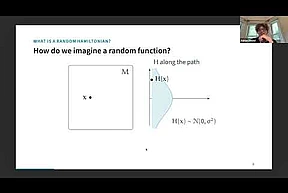
What is a random Hamiltonian diffeomorphism? In this talk, we
propose an answer by constructing a family of probability measures
on the group Ham(M) of Hamiltonian diffeomorphisms of a closed
symplectic manifold M. We outline the construction, which...