Juan Maldacena

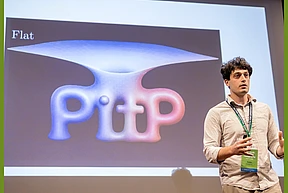
While scientists have demonstrated how the holographic principle works in hypothetical, highly curved spaces, such as Anti-de Sitter space—an approach pioneered by Juan Maldacena, Carl P. Feinberg Professor in the School of Natural Sciences—they are still trying to determine if equivalent field theories can replicate these effects in so-called "flat space." This year’s Prospects in Theoretical Physics (PiTP) program probed this fascinating topic.

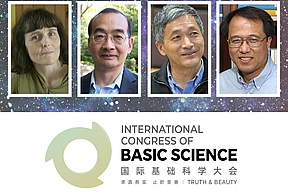
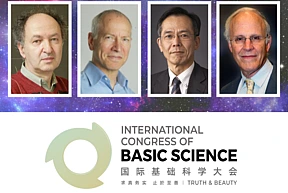
All three recipients of the 2026 International Congress of Basic Science (ICBS) Medal in Mathematics have links to the Institute’s School of Mathematics: Claire Voisin, Distinguished Visiting Professor (2014–15); frequent IAS scholar Horng-Tzer Yau; and Shou-Wu Zhang, Member (1991–92). Xiao-Gang Wen, Member (1990–91) and IBM Einstein Fellow (2022–23) in the School of Natural Sciences, was also recognized with a Physics Medal.

According to a recent article from Quanta Magazine, researchers working at the frontier of quantum physics have uncovered a “puzzling conundrum.” The story began nearly three decades ago, when Juan Maldacena, Carl P. Feinberg Professor in the School of Natural Sciences, demonstrated that complex calculations in string theory could be dramatically simplified using concepts from particle physics through a “holographic” correspondence.