Shadows of Spacetime: PiTP 2026 Investigates Celestial Holography
Just as a flat, two-dimensional piece of holographic film contains all the coded information needed to shine a realistic 3D image into the middle of a room, the holographic principle proposes that our three-dimensional reality might be a complex “shadow” or hologram projected by the math and physics happening on a flat, 2D cosmic boundary.
While scientists have successfully demonstrated how this works mathematically in hypothetical, highly curved spaces, such as Anti-de Sitter space—an approach pioneered by Juan Maldacena, Carl P. Feinberg Professor in the School of Natural Sciences—they are still trying to determine if equivalent field theories can replicate these exact effects in so-called “flat space,” i.e., the conditions we inhabit on Earth.
The ongoing quest to prove this holographic framework was the subject of this year’s Prospects in Theoretical Physics (PiTP) program, hosted on the Institute for Advanced Study campus from July 20–31. The program welcomed 77 advanced graduate students and postdoctoral scholars for an intensive two-week workshop. Participants hailed from 28 countries and represented 47 institutions.
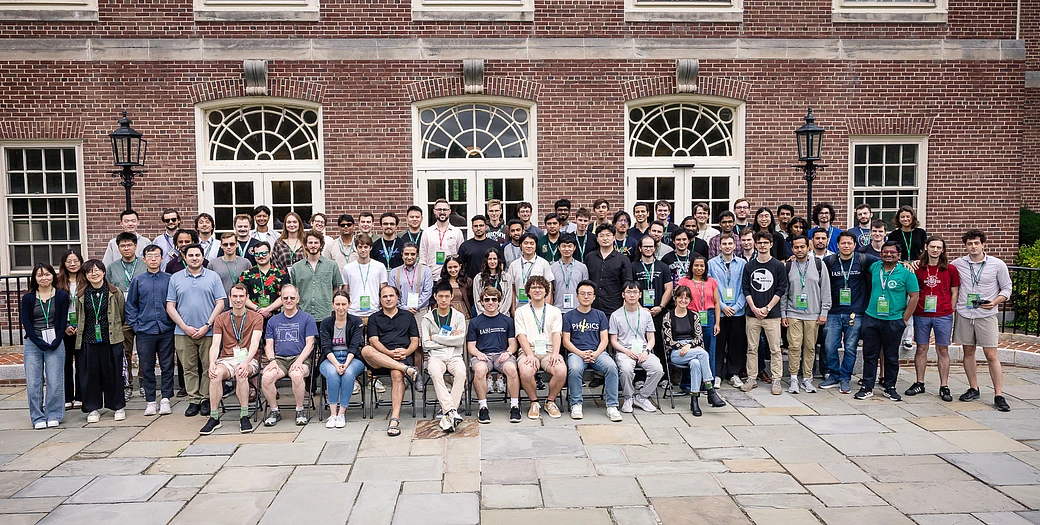
Beginning with a bootcamp on celestial holography, participants developed a working understanding of how scattering amplitudes, asymptotic symmetries, and twistor methods combine to define a holographic description of flat spacetime. The program then built bridges to recent advances in amplitudes, bootstrap techniques, and string theory constructions. In addition to a series of lectures, the PiTP events included poster sessions, gong show presentations, and informal opportunities to exchange ideas during study breaks, as well as over tea and coffee.
The program was organized by Nima Arkani-Hamed, Gopal Prasad Professor in the School of Natural Sciences; Jordan Cotler of Harvard University; and Sabrina Pasterski, who is based at Perimeter Institute. It was supported, in part, by the Simons Collaboration on Celestial Holography.
Many of the lectures from the program are available to view via the PiTP 2026 IAS YouTube playlist.