Walking the "Two-Way Street" of Math and Physics: Q&A with Christopher Beem
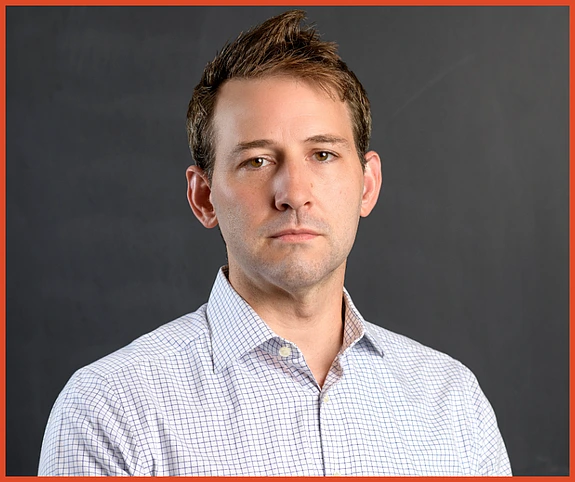
Christopher Beem, J. Robert Oppenheimer Visiting Professor in the School of Natural Sciences, is a theoretical physicist and mathematician who specializes in the study of quantum field theories. He comes to the Institute on sabbatical from the University of Oxford, where he is a Professor of Mathematics and Theoretical Physics at the Mathematical Institute and an Official Fellow and Tutor in Mathematics at St. John's College. His Membership in the 2026–27 academic year represents Beem's second stint at IAS; earlier in his career, he was a postdoctoral Member in the School of Natural Sciences from 2013–16.
What is your elevator pitch for describing your research?
My current research focuses largely on connections between quantum field theory and pure mathematics. Quantum field theory is the enormously successful theoretical framework developed by physicists to describe the interactions of elementary particles and, more generally, quantum-mechanical systems with (infinitely) many degrees of freedom. What is perhaps surprising is that it has also turned out to be a fertile source of new mathematics. Questions that arise naturally when one thinks carefully about quantum fields—about their symmetries, say, or about how they respond to the shape of the space they inhabit—have given rise to many important ideas in geometry, topology, algebra, and representation theory. The influence also runs in the other direction, since the mathematical structures uncovered in this way often provide tools with which one can understand the physics more deeply, and it is this two-way street that I explore in my own work.
Have any IAS scholars, past or present, influenced or impacted your research?
The Institute has been something of a mecca for this type of research for several decades, so many of the people whose work has been most influential in my career have been scholars here at some point. Edward Witten, Professor Emeritus in the School of Natural Sciences, is, of course, a towering figure in the field. The very idea that quantum field theory can serve as an engine for generating (and answering) questions in pure mathematics originates largely from his work. The influence of Nathan Seiberg, Charles Simonyi Professor in the School, on the study of supersymmetric quantum field theory (to name just one area) is similarly hard to overstate. From the more recent generation, Davide Gaiotto’s work, including during his time as a long-term Member (2007–12) here at IAS, has been an ongoing source of inspiration to me.
You are returning to IAS for a second Membership. What are your favorite memories of your first visit to the Institute? What are you hoping hasn’t changed?
My first Membership at the Institute was as a postdoc, and the great highlight of those years for me was the community of postdoctoral Members in the School of Natural Sciences. Working and living within a short walk of a group of brilliant people at the same stage of their careers, all of us intensely focused on research, produced a very special camaraderie that I cherish to this day. Returning as a somewhat older person, I don’t expect it to feel quite the same, but I am nonetheless looking forward to the mixture of community and intense intellectual activity that characterizes Institute life.
What changes or evolutions currently occurring within your field do you find most exciting?
Like many, I am watching the developing capabilities of generative and agentic AI in mathematics and physics with a mixture of excitement and trepidation. My corner of the subject has often advanced by noticing patterns (or their violation) in interesting examples, and tools that can generate and check examples at a superhuman scale are changing what it is feasible to ask. I am thankful to be on sabbatical at IAS at this dynamic time so I can give serious thought to what the most useful questions might be in a world with such tools (and their successors).
What do you find to be the best part of your workday?
In Oxford, the best part of my day is when I first arrive at my office in the morning and have a chance to reflect and strategize before the demands of the day catch up to me. At the Institute, I prefer the last couple of hours of the workday, which begin with afternoon tea and often turn into an hour of brainstorming or discussing new ideas with other Members.
You have studied and worked at esteemed institutions in California, New York, New Jersey, and the UK. How has this cross-continental academic journey influenced your scholarly perspective?
Each institution where I have worked has had its own local scientific culture, with a significant axis of variation being how one balances mathematical rigor against physical intuition in a discipline that sits somewhere close to the boundary between physics and mathematics. I like to think that having spent time in each of these environments has enriched my own research and given me a breadth of perspective that I would not have acquired in any one place.

Do you have any items on your bucket list to complete while you are in Princeton?
In the last couple of years, I have taken up rock climbing (as a middle-aged physicist, I realize this is doubly clichéd). One of the most storied climbing areas in the country, the Shawangunk Ridge, is only a couple of hours north of Princeton, so at the top of my non-academic bucket list is to get up there a few times this year and, if they approve, to get my two boys (aged four and seven) onto the rock as well.
IAS has a long-standing tradition of afternoon tea. As an incoming IAS scholar, how do you drink your tea?
Despite spending a decade in England, I have never really become a tea drinker, and I get my caffeine from coffee instead. I am unreasonably excited about the espresso machine in the Simons Center for Systems Biology, which has appeared since my first stint here.