Exhibition Explores the Moroccan Fieldnotes that Shaped Modern Anthropology
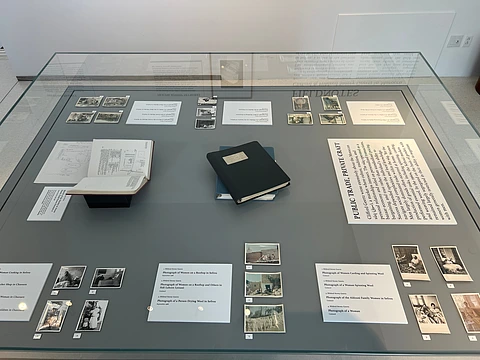
Displayed in the Rubenstein Commons gallery, “Fieldnotes: Clifford and Hildred Storey Geertz in Morocco” is an exhibition drawn from archival materials documenting anthropological fieldwork conducted between 1965 and 1971. Curated by the Shelby White and Leon Levy Archives Center, the collection offers insight into the research methods and collaborative work that informed one of the most influential anthropological projects of the twentieth century. The exhibition was co-curated by Archivist Caitlin Rizzo, Digital Collections Archivist Karen Clausen-Brown, and Research and Curation Specialist for the Archives Lorenza Pescia De Lellis.
The displays center on the work of Clifford Geertz, who joined the Institute Faculty in 1970. Widely regarded as one of the leading American cultural anthropologists of his time, Geertz served as the founding Professor of the School of Social Science from 1973 until his death in 2006. The exhibition also features the work of a wider research team, which included Hildred Storey Geertz, the first female chair of the Anthropology Department at Princeton University and, at the time, Clifford Geertz’s wife, and Lawrence Rosen, Member (1970–71) and Visitor (2017–18) in the School of Social Science, among others.
The materials on display trace the development of research that culminated in the publication of the book Meaning and Order in Moroccan Society in 1979. While working on the book, the team members lived in Sefrou, a Moroccan city in the Middle Atlas Mountains. Their field notes, diagrams, photographs, maps, and indexes, all on display in the exhibition, reveal inquiry grounded in personal engagement and interpretation rather than generalization. Through what Geertz later went on to describe as “thick description,” the team sought to understand the cultural significance of everyday tasks, emphasizing the complexity of cultural life. Their goal was not to offer a complete answer to the question of Moroccan culture, but rather to identify key societal symbols and their meanings.
Of particular note is the index to the fieldnotes, which records the collaborative and iterative nature of the research process undertaken in Sefrou. Marked throughout with the researchers’ initials to indicate authorship and contribution, the index records how observations, interpretations, and revisions continued long after the fieldwork itself. The fieldnotes reveal the interrelationship between anthropologists who revisited and reinterpreted one another’s work and the subjects of their study, producing a dense network of ideas.
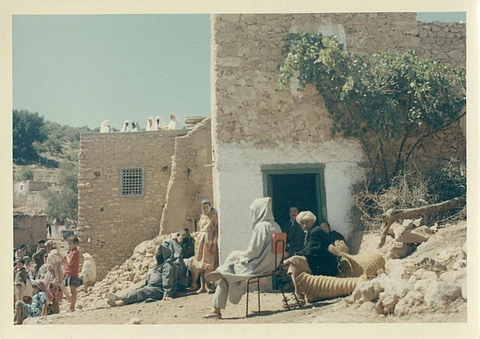
The exhibition also emphasizes how Geertz and his team’s work both avoids generalizations and explores how different elements of cultural life are inextricable. For example, the sūq—the public market—was a space in which men sold cattle and other goods often made by women at home. One symbolic image of the market, on display in the exhibition, illustrates this dynamic: women stand on a rooftop in the distance, overlooking the sūq. But instead of viewing the sūq and the home as separate worlds, the anthropologists understood them as deeply interdependent. While earlier anthropologists might have categorized the exclusion of women from the market (where they were not permitted unless accompanied by a male guardian) as simply discrimination, the Geertzes set aside judgement. They recognized the home not as an isolated space but rather an integral component of the cultural network that sustained market life.
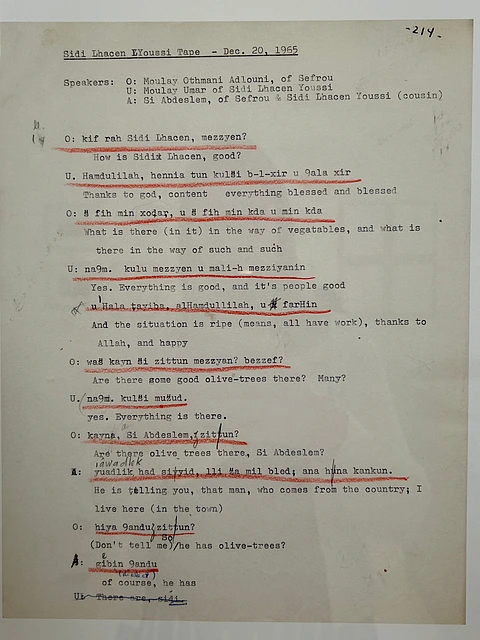
Another key strength of the anthropologists’ research, highlighted by the exhibition materials, is its recognition of the limitations both of the questions the team set out to answer and of their research process. The language spoken in Morocco is Darija, a dialect of Arabic, but the researchers knew only standard Arabic. In the methodology section of their final book, they acknowledged that this would at best provide an incomplete picture of Sefroui society. On display are two versions of annotated transcripts of the Sīdī Lahcen Lyoussi Tapes, which record a conversation between three Moroccan men. Ultimately, the Geertzes chose to transcribe what they heard phonetically to preserve the original speech, as opposed to translating it directly to standard Arabic, underscoring their awareness of the importance of language to cultural understanding. This self-awareness from the researchers is part of what distinguishes the project and highlights its sustained resistance to cultural generalization.
Significantly, the Geertzes brought to Morocco the ideas, research habits, and analytical frameworks they had developed during a previous period of collaborative research. Prior to Morocco, they had spent an even longer period conducting formative fieldwork in Indonesia, specifically on the islands of Java, Bali, and Sumatra. Their foundational work in Indonesia set the stage for how they approached their subsequent research in Morocco. Consequently, Morocco represented their second long-term research project in a region completely distinct from the first, connected only by widely shared Islamic religious doctrines and practices. It is rare for anthropologists to dedicate such extensive time to two disparate geographic areas, especially since doing so requires mastering entirely different languages—such as Dutch, Javanese, Indonesian, and Balinese in Indonesia, compared to French and Arabic in Morocco.
“Fieldnotes: Clifford and Hildred Storey Geertz in Morocco” highlights the legacy of anthropological work that Geertz developed at the Institute. The team’s research differs from that of their predecessors in the approach to the people they studied, which is marked by generosity, curiosity, and a sense of play, while maintaining the critical distance necessary for interpretation. Meaning and Order in Moroccan Society—the book derived from the exhibited materials—is regarded as a foundational work in symbolic or interpretive anthropology. It reframed not just how researchers approach their work, but the very questions they ask.
“Fieldnotes: Clifford and Hildred Storey Geertz in Morocco” is on display in Rubenstein Commons until October 2, 2026. The exhibition is open to all members of the Institute community. Members of the public are also welcome. Those interested in scheduling a tour should contact the Archives Center at [email protected].
This exhibition is made possible thanks to the generosity of Karen Blu, Member (1976–77) and Visitor (1978–79) in the School of Social Science, who donated these archival materials to the Shelby White and Leon Levy Archives Center.