Exhibiting Matisse: The Stations of the Cross at the Baltimore Museum of Art
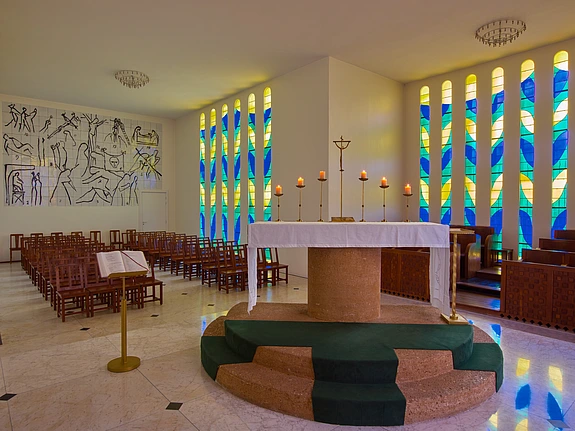
A lot has been written on Matisse's Chapel of the Rosary in Vence (a small town close to Nice in the south of France) since its inauguration in June 1951. This is a building on which the artist worked exclusively for nearly four years at the end of his life, conceiving it as an indivisible whole and planning it down to the smallest details—from the stone chosen for the altar (because it resembled bread) to the colorful garments of the priest that contrast with the black-and-white outfit of the Dominican sisters for whom it was destined, and the geometric pattern formed by the blue-and-white glazed roof tiles. It has long been celebrated as a "total artwork," with its delicate balancing act between three ceramic murals drawn in black on white and the colorful stained-glass windows that reflect on their shiny surfaces.
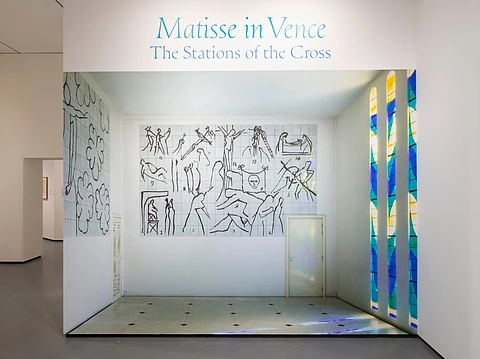
Yet in the vast literature on the Chapel, there is one key element that has been consistently neglected—which is all the more surprising given that Matisse made more sketches and preparatory studies for it than for any other work in his entire career! I am speaking of The Stations of the Cross, a mural that fills the back wall of the Chapel. It is as if Matisse scholars, with very few exceptions, haven't known what to make of it (some even went so far as to declare it a failure). There is actually a good reason for this, in that the mural does not look anything like a work by Matisse—gone are the sensuous curves, the gentle arabesques, and the decorative patterns that are part and parcel of his Edenic visual syntax. The artist himself acknowledged that what he called its "graffiti style" clashed with everything else in the Chapel, which is geared towards "tranquil contemplation": “I’m afraid this panel will shock the Vence believers, for it doesn’t really correspond to their conceptions […] The drawing is rough, very rough in fact; it will dismay most people who see it.”
Intrigued by the discrepancy between the phenomenal attention Matisse devoted to his Stations of the Cross mural and the paucity of commentaries it elicited—particularly since it has always been what I like best in his Chapel—I decided to mount an exhibition dedicated to the elaboration of this work, gathering as many of its preparatory drawings as possible so that one could follow step-by-step the evolution of Matisse's conception throughout the whole process. The exhibition, gathering some eighty-five drawings, opened this past fall at the Musée Matisse in Nice and is currently on view at the Baltimore Museum of Art, its second and last venue, where it will close at the end of June.


At first thought, the principle of such an exhibition seems nonsensical: given that Matisse thought of his Chapel as an ensemble, why would anyone want to focus on just one of its elements, The Stations of the Cross mural, and deliberately isolate it from the context that gives it its meaning? My response would be that it is not so much an extraction of the mural from its context that I envisioned, but rather an extension of that context to Matisse’s oeuvre in general and to the centuries-old tradition of Christian art.
Let me start by proposing that Matisse was possibly the least suitable artist to take on a topic such as "The Stations of the Cross." For one thing, he knew next to nothing about Christian iconography and had to learn it—which is why his preparatory drawings for the mural include so many sketches after Old Masters such as Mantegna, Dürer, or Rubens. Second, he had always despised works of art illustrating a text (here the text in question, the Scriptures, is one he was very little acquainted with, as a nonbeliever). Third, he never had much interest in narrative (he had actually very little talent for it—in the very few multi-figure paintings in which there is some interaction between the characters, nobody can understand what those are supposed to be doing). Fourth, unlike Picasso, he was extremely reluctant to represent violence or suffering—there is only a handful of violent scenes in his entire oeuvre, and none of them are very convincing as such.
Given all these handicaps, one wonders why Matisse embarked on such a venture. If the Chapel had been a commissioned work, it would have been easy to blame this anomaly on the sponsor, who would have imposed the subject of Calvary on the artist. But Matisse was in fact his own patron: he was the one who offered his Chapel to the Dominican sisters of Vence—who had asked him for nothing, save some advice—and it was he who found the funds to finance it, partly out of his own pocket. He surely discussed possible subjects for his three mural compositions with Brother Rayssiguier, the amateur architect who was his main partner in this project. But while the choice of a Virgin and Child and of a large Saint Dominic seems obvious for the other two murals of a building dedicated to the Rosary—whose ritual and worship were historically introduced by that saint himself—the same cannot be said for The Stations of the Cross. If a composition with multiple figures was being contemplated, why not a representation of Paradise, for example? Matisse had already tackled the theme in his 1906 Bonheur de vivre...
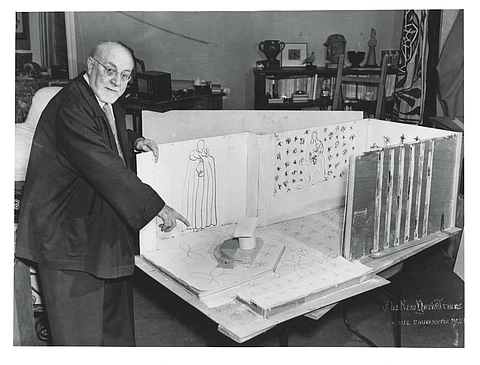
There is no foolproof explanation for why Matisse threw himself into the task with such a remarkable energy and resolve, as he was old (close to eighty) and sick (mostly bedridden). Contrary to what was suggested in the press at the time, he had not converted to Catholicism in old age. He was at the end of his career and had just finished an extraordinary series of paintings—known as the Vence Interiors (1946–48)—which count among his best. He had good reasons to assume they would be his last (staying for long hours in front of the easel had become impossible), and indeed they were, as he shifted mediums and turned to his famous technique of paper cutouts (which he used to fantastic effect when working on the Chapel's stained-glass windows). Perhaps there was some excitation about being challenged when entering a new chapter in life, his last? One factor that must have played a role, unbeknownst to his Dominican collaborators, is how much Matisse had been longing for an occasion to work again at the architectural scale. For three years, from 1931 to 1933, he had labored on The Dance, his great "decoration,” as it called it, for the Barnes Foundation, and he had been extremely vexed that the French State did not commission anything from him for the Paris World Fair in 1937, while so many artists had been invited to participate. Matisse was not particularly interested in architecture per se, actually, but he was interested in the transformative effect his art can have on architecture. He said to Rayssiguier: “What interests me is bringing space and light into a volume that is not particularly interesting in itself,” adding: "I don’t need to make churches; there are other people to do that” (which also shows that, at least at first, the ecclesiastical function of the building was not a big concern for him).
Let us come back to this notion of challenge. I have listed above several handicaps that Matisse had to overcome in order to come to grips with the topic of "The Stations of the Cross." But I have kept in abeyance the most important issue, which is structural, in the sense that the traditional scheme of "The Stations of the Cross," which is linear, is in direct opposition to Matisse's entire aesthetic, which is tabular. He had always conceived all his works (except the sculptures) as something to be taken in at a glance because they each were conceived as a totality in which “the subject of a picture and its background have the same value” and where everything holds together because "everything is a matter of relationships." At the same time, this non-hierarchical conception of the pictural field implies that it is decentered and afocal. After a work has been taken in all at once and the gaze of the beholder wanders, his or her eye can rest by lingering for a moment on visual “hooks,” but these respites are temporary. The critic Gaston Diehl asked him two questions: “Do you prefer to fashion an image that can be taken in all at once, or one that is taken in by degrees?” and “Do you think that the image should stay in the spectator’s mind for a long time?” Matisse gave just a single answer: “I try to make sure the image is whole as it enters the spectator’s mind, after which it acts in accordance with its depth of expression, and that of the spectator’s mind.” It is difficult to imagine such a scenario when the work must offer the viewer a perfectly linear script with clearly individuated stages.


As is well known, "The Stations of the Cross" form a sequence of discreet scenes that are usually spatially distant from one another (whether inside a church or outside it). The present codification into fourteen stations is relatively recent—it was imagined by a theologian in the seventeenth century but was only officialized in the early nineteenth century. At the outset of this tradition, toward the end of the fifteenth century, there were only seven stations, each corresponding to a particular holy place along the Via Dolorosa in Jerusalem. “The Way of the Cross,” as it is often called in English, was conceived as a substitute for the faithful who did not have the opportunity to make a pilgrimage to the Holy Land and walk in the footsteps of Christ ascending to Calvary under the supervision of the Franciscan friars in charge of the chapels built along the road.
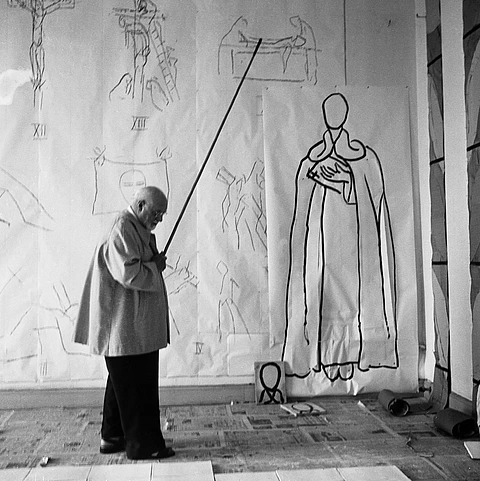
If Matisse had kept to the structure established in the nineteenth century and created fourteen panels lined up in a row on a wall of his Chapel, he would only have had to deal with the two problems identified so far—the iconographic and the narrative ones. Since the ordering of the sequence is preordained, he could have conceived of each of the fourteen panels separately, without any complication. But surprisingly, he accepted right away Rayssiguier’s idea of representing all the Stations on a single panel—an utter rarity in the entire history of Western painting. No less surprisingly, he also immediately adopted a “boustrophedon” disposition for the succession of scenes, starting at the lower left corner of the mural and ending at the upper right. It might also seem peculiar that he made only a handful of rudimentary sketches of the overall composition, but this was actually in keeping with a key tenet of his aesthetic, namely that any of his bi-dimensional works must always be conceived at their exact scale of 1:1. In order to comply with this requirement (and the self-proclaimed prohibition against the traditional method of squaring up and enlarging a small drawing), he waited to seriously mull over its overall composition until he could draw on a wall big enough to accommodate the size of his mural. He moved back from his villa in Vence—where he had taken refuge during the war when the bombing of Nice by the Allies were feared—to his grandiose suite in the Hôtel Regina in which a room was of the exact dimensions he projected to give to his Chapel. There, picking up again a graphic instrument he had not used since his work on the Barnes mural—a seven- or eight-foot long bamboo stick to the end of which a piece of charcoal had been fixed—he sketched his mural time and again, constantly changing its configuration. He had not been idle before his move back to Nice, though: for about a whole year, he had drawn each station separately, his most elaborate studies (mainly in charcoal and some rather realistic) being on sheets of paper of dimensions that roughly corresponded to the space that would be allotted to each station on the mural. He continued to make such separate studies—notably for the twelfth Station (the crucifixion)—even after he considered his wall-size design finished and was just waiting for the ceramic titles on which he would paint to be delivered to him. But this was, as he said, "not to lose contact," a phrase one would expect to come out more from Jackson Pollock's mouth than from that of Matisse. Perhaps this is perfectly congruent with the manner in which he painted the ceramic tiles that were laid for him on the floor: very quickly, in broad gestures, with a long and heavy brush loaded with black enamel paint, while he looked at his wall drawing. The brushwork of the mural installed in the Chapel looks eerily similar to that of Abstract Expressionist painter like Willem de Kooning, and some of the preparatory drawings, among his most poignant, such as the charcoal sheet on which the exhibition ends—the Dead Christ, looking like a slab of lead—announce the brutalism of Richard Serra.
The exhibition "Matisse in Vence: The Stations of the Cross" remains on view at Baltimore Museum of Art through June 28, 2026. In addition to a mural-size photograph of Matisse’s completed work, drawings from the Musée Matisse Nice, the Dominican Sisters of Vence, and private collections, are on display. Many of these drawings have never before been shown together, nor in the U.S. The exhibition is accompanied by a comprehensive catalog produced under the direction of Yve-Alain Bois, with contributions from Alix Agret and Aymeric Jeudy.