In this talk, we explore new techniques to probe the analytic
structure of scattering amplitudes in perturbative Quantum Field
Theory. The goal of this approach is to leverage symmetries,
limits, and analyticity in order to circumvent the explicit...
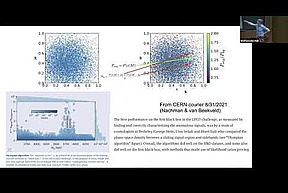
Recent radio observations of inflowing and outflowing plasma in
the vicinity of supermassive black holes are linked to simple
phenomenological models via general relativistic
magnetohydrodynamic simulations through a methodology called
"Observing"...
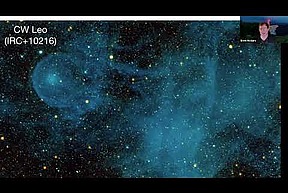
Polycyclic Aromatic Hydrocarbons (PAHs) have been implicated as
a large reservoir of reactive carbon in the interstellar medium
since the 1980s. PAHs have been widely attributed as the carriers
of the unidentified infrared bands where their...
Quantum computers employ quantum circuits to implement
algorithms. They are composed of quantum gates that act on near
neighbors according to some spatial geometry. They are particular
instances of quantum cellular automata (QCA), the set of...
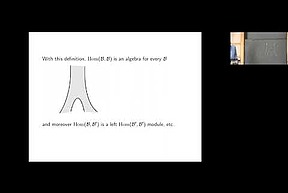
Recently P. Etingof, E. Frenkel, and D. Kazhdan, following
earlier contributions by R. Langlands and J. Teschner, described an
“analytic” approach to the geometric Langlands correspondence, in
which the main ingredients are quantum states and...
One of the best laboratories to study strong-field gravity is
the inner 100s of kilometers around black holes and neutron stars
in binary systems with low-mass stars like our Sun. The X-ray light
curves of these systems show variability on...