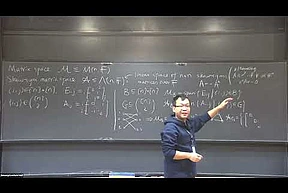
In 2021 Avi gave a talk titled “Linear spaces of matrices” (see
https://www.youtube.com/watch?v=H1H0OkZfZXw).
As shown there, the study of linear spaces of matrices (which we
call matrix spaces) arises naturally (and independently) in many
different...
AI progress is accelerating, and now the leaders expect
“artificial general intelligence” (AGI) in 2 to 3 years. While
difficult to believe, we must prepare for the possibility. We can
take some lessons from previous episodes in which computers...
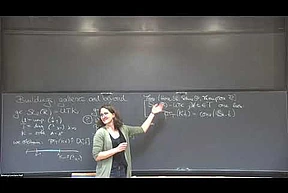
Originally introduced as analogs of symmetric spaces for
groups over non-archimedian fields buildings have proven useful in
various areas by now. In this talk I will introduce (Bruhat-Tits)
buildings, combinatorial toolkits to study them and
their...
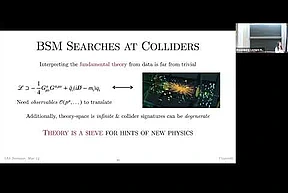
Despite the undeniable success of the Large Hadron Collider
(LHC), Beyond the Standard Model (BSM) physics remains elusive. In
this talk, I will outline a multifaceted strategy to maximize
discovery potential at current and future high-energy...
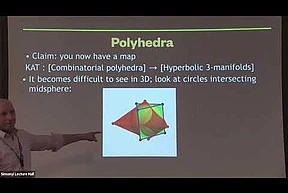
A construction of Thurston assigns a hyperbolic 3-manifold to
any polyhedron; a natural question is: which such are arithmetic?
We report on ongoing work aiming to answer this question.
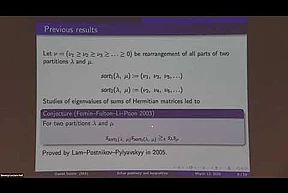
The ring of symmetric functions has a linear basis of Schur
functions sλ indexed by partitions λ=(λ1≥λ2≥…≥0).
Littlewood-Richardson coefficients cνλ,μ are the structure
constants of such a basis.
A function is Schur nonnegative if it is a linear...
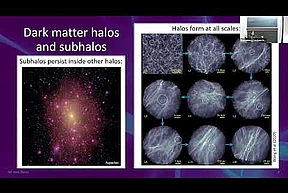
The first structures of particle dark matter form by
gravitationally condensing out of the smooth mass distribution of
the early universe. This formation mechanism leaves these "prompt
cusps" with uniquely compact r^-1.5 density profiles and
links...
A remarkable result of Brändén and Huh tells us that volume
polynomials of projective varieties are Lorentzian polynomials. The
dual notion of covolume polynomials was introduced by Aluffi by
considering the cohomology classes of subvarieties of a...