The Pila–Zannier strategy has proved to be a particularly
fruitful approach: first applied to reprove the Manin–Mumford
conjecture, it was later exploited decisively in proofs of the
André–Oort conjecture. Crucially relying on a recent
counting...
Rank 1 transformations are a long studied, flexible class of
measure preserving transformations. King proved a variety of deep
results about rank 1 rank transformations including: A) A rank 1
transformation’s centralizer is the weak closure of its...
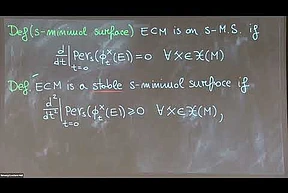
In the '80s, Yau conjectured that every closed Riemannian
3-manifold contains infinitely many smooth minimal hypersurfaces.
In this talk, I will present a Yau-type existence result for
nonlocal minimal surfaces and discuss how one can recover
the...
A closed hypersurface in a contact manifold is convex if it
admits a transverse contact vector field. A closed hypersurface is
robustly non-convex if it cannot be smoothly approximated by a
convex hypersurface. The existence of such hypersurfaces...
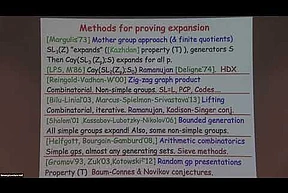
I plan to survey the many ways we have today of constructing
expanding Cayley graphs of finite groups, and the ideas behind
their analysis (some useful beyond that purpose). I want to
highlight that despite a comprehensive understanding of
achieving...
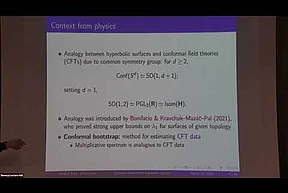
Given a compact hyperbolic surface of fixed topology, we
consider its Laplace eigenvalues together with the structure
constants for multiplication with respect to a suitable orthonormal
basis of Laplace eigenforms. These numbers obey algebraic...
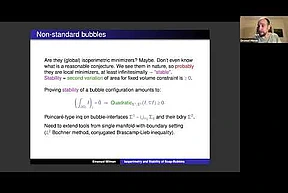
We develop the spectral analysis of the Jacobi operator on the
interfaces of soap-bubble clusters. By Plateau's laws, these always
meet in threes at $120^{\circ}$-angles, and thus naturally interact
via 3 linearly independent "conformal" boundary...
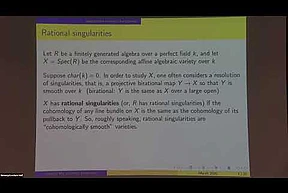
Singularities are local properties of algebraic varieties. For
example, the solution set of a polynomial in several variables such
as $y^2=x^3$ has a singularity at the origin $(0,0)$. In algebra,
one often studies singularities through the quotient...
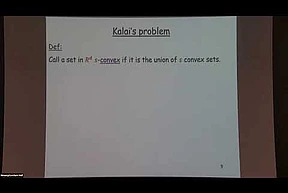
We define and study an extension of the notion of the
VC-dimension of a hypergraph and apply it to establish a Tverberg
type theorem for unions of convex sets. We also prove a new Radon
type theorem for unions of convex sets, settling an open...
Hilbert, motivating his list of 23 problems, mentions the
arithmetical formulation of the concept of the continuum in the
works of Cauchy, Bolzano and Cantor, and the discovery of
non-Euclidean geometry by Gauss, Bolyai and Lobachevsky, as...