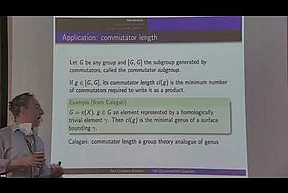
I will discuss a recent work constructing quasimorphisms on the
group of area and orientation preserving homeomorphisms of the
two-sphere. The existence of these quasimorphisms answers a
question of Entov, Polterovich, and Py. As an
immediate...
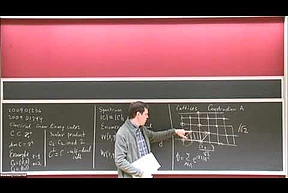
I will review recent progress connecting (quantum) codes with
two-dimensional conformal field theories of the Narain type. In the
first part of the talk I will show how codes can be used to
construct CFTs with large spectral gap. In the second part...
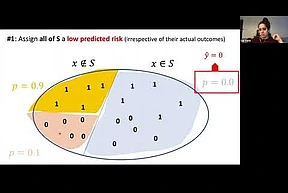
As machine learning is widely deployed, it is increasingly
important to ensure that predictors will perform well not only on
average (across the entire population), but also on specific
socially salient subgroups. In this talk, I will present...
When, on an autumn Medina night in 61/680, the night that saw
al-Ḥusayn killed, Umm Salama was torn from her sleep by an
apparition of a long-dead Muḥammad, she slipped effortlessly into a
progression of her co-religionists who, irrespective of...
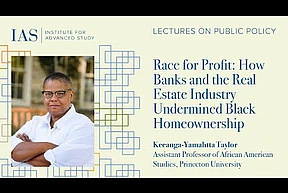
Professor Keeanga-Yamahtta Taylor’s presentation will examine
the ways that housing policies inspired and shaped by private
sector organizations undermined the federal government's ability to
enforce fair housing rules and regulations long after the...
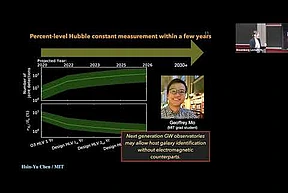
The detections of gravitational waves from compact binary
mergers and the followup observations of electromagnetic emissions
together provide a powerful and independent tool to explore the
Universe. With successive upgrades to the LIGO and Virgo...
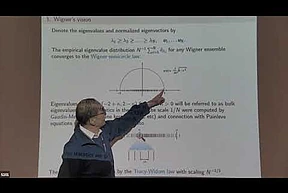
In the first of two lectures I will present a pedagogical
exploration of perhaps the simplest random matrix model, the
Gaussian Unitary Ensemble. It gives the Airy model in the double
scaling limit. I will first review the features that we
usually...