Given a trivalent plane graph embedded in the Euclidean plane
(up to isotopy), Treumann and Zaslow constructed and studied a
certain associated Legendrian surface embedded in standard contact
R5, nowadays referred to as a Legendrian 2-weave. Using...
The fundamental equations of fluid dynamics exhibit
non-uniqueness. Is this a mathematical fluke, or do the equations
fail to uniquely predict the motion of fluids? In this colloquium,
we present recent mathematical and physical progress toward...
Over the last three decades, the online bipartite matching (OBM)
problem has emerged as a central problem in the area of Online
Algorithms. Perhaps even more important is its role in the area of
Matching-Based Market Design. The resurgence of this...
I will review two combinatorial constructions of integrable
systems: Goncharov-Kenyon construction based on counting perfect
matchings in bipartite graphs, and
Gekhtman-Shapiro-Tabachnikov-Vainshtein construction based on
counting paths in networks...
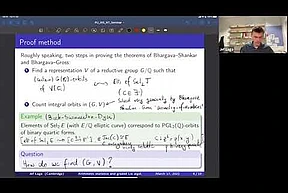
I will explain how various results in arithmetic statistics by
Bhargava, Gross, Shankar and others on 2-Selmer groups of Jacobians
of (hyper)elliptic curves can be organised and reproved using the
theory of graded Lie algebras, following earlier...
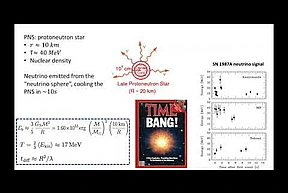
Core-collapse supernovae (CCSN) are efficient laboratories to
explore physics beyond the standard model (SM). In particular, they
have been used to put strong constraints on axion and axion like
particles, and on many other motivated extensions of...
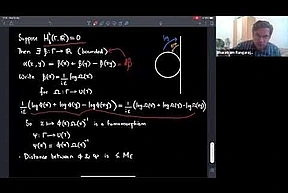
In ongoing joint work with Glebsky, Lubotzky, and Monod, we
construct an analog of bounded cohomology in an asymptotic setting
in order to prove uniform stability of lattices in Lie groups (of
rank at least two) with respect to unitary groups...
Two recent and seemingly-unrelated techniques for proving mixing
bounds for Markov chains are:
(i) the framework of Spectral Independence, introduced by Anari,
Liu and Oveis Gharan, and its numerous extensions, which have given
rise to several...