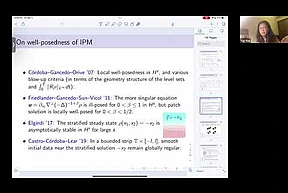
The incompressible porous media (IPM) equation describes the
evolution of density transported by an incompressible velocity
field given by Darcy’s law. Here the velocity field is related to
the density via a singular integral operator, which is...
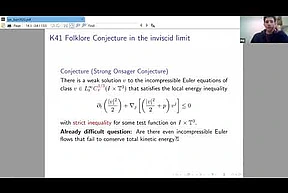
I will discuss the construction of continuous solutions to
the incompressible Euler equations that exhibit local dissipation
of energy and the surrounding motivations. A significant open
question, which represents a strong form of the Onsager...
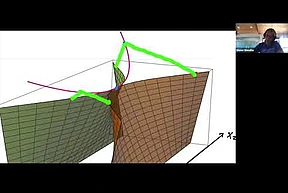
I will describe a new geometric approach for the shock formation
problem for the Euler equations. A complete description of
the solution along the hypersurface of first singularities or
preshocks will be given.
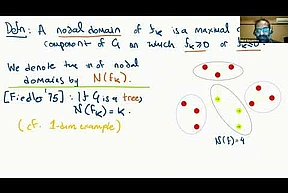
A nodal domain of a Laplacian eigenvector of a graph is a
maximal connected component where it does not change sign.
Sparse random regular graphs have been proposed as discrete toy
models of "quantum chaos", and it has accordingly been
conjectured...
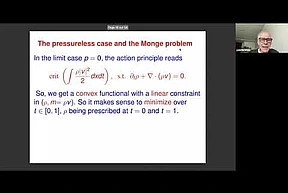
The quadratic Monge optimal transportation problem can be
revisited in Euler's language of Hydrodynamics as was explained by
Jean-David Benamou and the speaker about 20 years ago. It turns out
that Einstein's theory of gravitation, at least in...
The black hole information paradox — whether information escapes
an evaporating black hole or not — remains one of the greatest
unsolved mysteries of theoretical physics. The apparent conflict
between validity of semiclassical gravity at low...
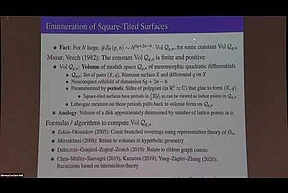
In this talk we will describe the behaviors of flat surfaces and
geodesics on hyperbolic surfaces, as their genera tend to infinity.
We first discuss enumerative results that count the number of such
surfaces or geodesics (which can be viewed as...
Andras Juhasz has explained in his talk how machine learning was
used to discover a previously unknown relationship between
invariants in knot theory. This relationship is a connection
between a classical knot invariant (the signature) and a new...
In this talk, I will establish a sharp bound on the growth of
cuspidal Bianchi modular forms. By the Eichler-Shimura isomorphism,
we actually give a sharp bound of the second cohomology of a
hyperbolic three manifold (Bianchi manifold) with local...