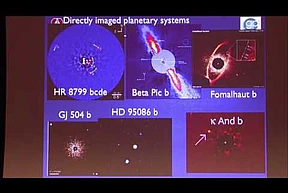
With current technology, young (<100 Myr) planets can be
directly imaged - resolved from their parent star - in the
near-infrared with adaptive optics. I will discuss results from
such imaging, particularly the four-planet system orbiting HR8799.
The outer two planets have been characterized spectroscopically
using adaptive optics on the Keck telescope, showing
non-equilibrium chemistry as well as evidence of composition
enhanced in C/O from the original stellar nebula. The next step in
direct imaging is Gemini Planet Imager and its counterparts on
other telescopes. GPI is a a facility-class instrument operating on
the Gemini South telescope, combining advanced adaptive optics with
a coronagraph and near-infrared integral field spectrograph. Almost
an order of magnitude more sensitive than current instruments, GPI
had first light in November 2013. I will present an overview of the
instrument and early science results including the orbit and
spectrum of the planet Beta Pictoris b, polarization of the HR4796A
circumstellar dust disk, and the status of the 600-star GPI
Exoplanet Survey. Finally, I will discuss the potential of the
WFIRST/AFTA space telescope for direct exoplanet imaging.
http://www.ias.edu/sns/~seminar/colloquia.shtml