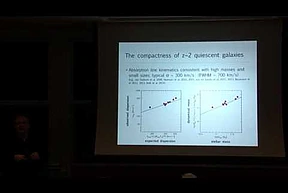
The talk begins in 2005, with the unexpected discovery that
massive early-type galaxies were extremely compact at redshifts
z~2. It is now thought that the remarkable size growth of these
galaxies from z=2 to z=0 is largely due to minor mergers;
the...
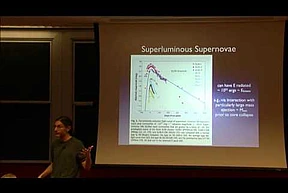
In the last few years of the lives of massive stars, fusion in
the core of the star produces a nuclear power that greatly exceeds
the Eddington luminosity. This drives vigorous convection in
numerous core and shell burning phases. I describe the...
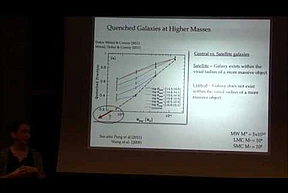
Environment plays a major in role in the evolution of galaxies.
This is particularly true of low mass dwarf galaxies where more
massive galaxies dramatically affect the local gravitational
potential. Isolated galaxies offer a unique test bed for...
Cosmic rays comprise only about one billionth of interstellar
particles in the Milky Way, but have as much energy as the thermal
gas. Low energy cosmic rays affect the chemistry and thermodynamics
of interstellar through collisional processes...
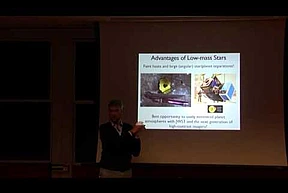
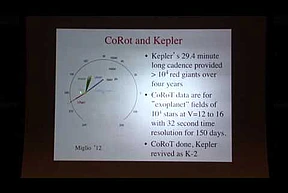
Recent results from Kepler and ground-based exoplanet surveys
suggest that low-mass stars are host to numerous small planets.
Since low-mass stars are intrinsically faint at optical
wavelengths, obtaining the Doppler precision necessary to detect...
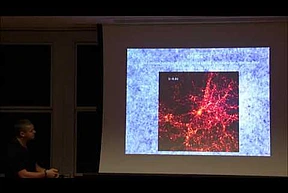
Galaxy formation is a complex, hierarchical, highly non-linear
process, which involves gravitational collapse of dark matter and
baryons, supersonic, highly compressible and turbulent flows of
gas, star formation, stellar feedback, as well as...
The Sun does not shine at GeV energies on its own power, but
because cosmic rays interact with its matter and light. By
observing and modeling these interactions in and near the Sun, one
may learn about cosmic-ray propagation in the inner...
The source of about half of the heaviest elements in the
Universe has been a mystery for a long time. Although the general
picture of element formation is well understood, many questions
about the nuclear physics processes and particularly the...