The James Webb Space Telescope (JWST) is finding earlier and
brighter sources than expected. In this talk I will explore how
these new observations fit (or don’t) within our cosmological and
galaxy-formation models. First, I will discuss the...
The distribution of matter on very large scales - the so-called
large-scale structure - contains clues, hidden within its
statistics, about the origin and evolution of the Universe. While
the gravity-only evolution of dark matter can be modelled...
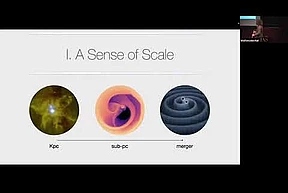
Supermassive black hole mergers are extraordinary cosmic
phenomena characterized by their immense energy release, producing
gravitational waves that can rival the total light output of all
stars in the universe within a short time frame. These...
How and where do black hole mergers form in our Universe? After
10 years of GW science with LIGO/Virgo/Kagra, there still seems to
be no direct indication of what the underlying astrophysical
formation channels are. I will present ideas and ongoing...
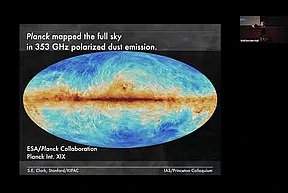
The interstellar medium (ISM) is a turbulent, multi-phase,
magnetic environment. It is home to vastly different gas phases,
from cold, dense clouds to hot, tenuous plasma. Magnetic fields
thread this interstellar environment, helping to sculpt...
At the center of nearly every galaxy in the Universe resides a
supermassive black hole. When galaxies collide, their supermassive
black holes sink to the center of the newly forming galaxy. There
in this nascent galactic nucleus a supermassive black...
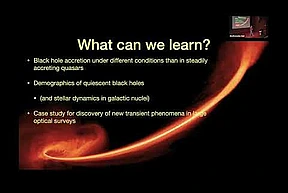
Over the last decade, large optical time-domain surveys have
systematized the discovery of transient flares of emission
associated with the tidal disruptions of stars by supermassive
black holes. These tidal disruption events (TDEs) are rare
events...
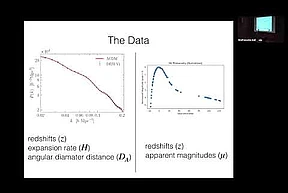
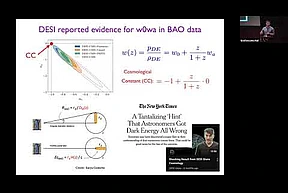
Cosmological data has opened up new vistas on fundamental
physics yet it is limited in its scope. While it has given us
tantalizing hints at how the Universe might be expanding, it is
unclear whether it can ever be used to find the
microphysical...
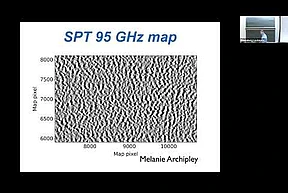
Surveys of the mm-wave sky are great resources for astrophysics
and cosmology. Sources that have been studied include solar system
objects, flaring stars, accreting black holes, dusty star forming
galaxies, and galaxy clusters, while cosmological...
I will present a program of extracting cosmological information
by combining effective field theory (EFT) techniques with data from
spectroscopic galaxy surveys. I will highlight previous successes
of this program and share recent results, including...