In this talk, I will give an overview of the types of problems I
work on in string phenomenology, with a specific view to how to
relate Calabi-Yau geometry to axions in four dimensions. I'll
discuss the broad-stroke features we find of axions in...
In this talk, I will present a holographic expansion, known as
the giant graviton expansion, of the thermal partition function of
free N=4 super Yang-Mills. We use the twistorial uplift of
self-dual N=4 SYM, which can be engineered in the...
Homotopy theory and category theory have the capability to
provide many insights into the structure of quantum field
theory. Using these tools I will explain a comprehensive
framework for characterizing the infrared (IR) phases of a
fermionic QFTs...
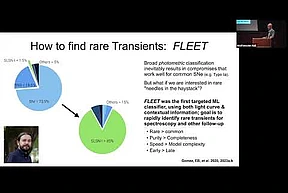
Time-domain surveys are finding tens of thousands (and soon
millions) of transient events. But how do we make new
discoveries of rare and exotic events? And how do we figure out
what causes and powers them? I will discuss several approaches
that...
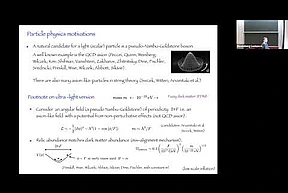
This will be a talk mostly on wave dark matter - if the dark
matter constituent is lighter than about 10 eV, dark matter is best
thought of as a set of waves. After a brief introduction, we will
discuss two recent ideas that explore the implied wave...
Current pulsar timing array (PTA) projects are galactic-scale
gravitational-wave (GW) detectors whose sensitivity is approaching
the point at which a signal should become clearly detectable.
Despite the strong evidence reported in the literature, I...
I will discuss recent progress on a Grassmannian formulation of
correlation functions in the large-N O(N) vector model, motivated
by higher-spin holography. The formulation leads to a remarkably
simple n-point formula and suggests an underlying...
Recent cosmological data hint at a neutrino mass sum below the
minimum value physically allowed by neutrino oscillations, with a
preference for the opposite of massive neutrinos. Within ΛCDM,
Planck CMB, ACT+Planck+SPT CMB lensing and DESI DR2 BAO...
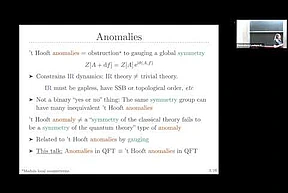
A key property of a global symmetry's anomaly is its order: the
smallest integer n for which the diagonal symmetry of the n-copy
system is anomaly-free. While many familiar lattice anomalies have
finite order, perturbative anomalies in the continuum...