In AdS/CFT, the black hole singularity is encoded as a
divergence in a certain analytic continuation of the two-point
function. This divergence corresponds to a null geodesic that
bounces off the singularity. In this talk, we will study the fate
of...
We study the double cone geometry proposed by Saad, Shenker, and
Stanford in de Sitter space. We demonstrate that with the inclusion
of static patch observers, the double cone leads to a linear ramp
consistent with random matrix behavior. This ramp...
The two-point correlation function of a massive
field, measured along an observer's worldline
in de Sitter (dS), decays exponentially in time.
Meanwhile, every dS observer is surrounded by a horizon
and the holographic interpretation of the horizon...
The no-boundary state in de Sitter offers a compelling framework
for specifying the initial conditions of our universe. Many (but
famously not all) features of the state agree beautifully with
empirical observations and have served as a foundation...
I will motivate current work in weak gravitational lensing with
cosmic and astrophysical puzzles. The evolution of dark energy, the
growth of structure and feedback from supermassive black holes are
some of the debated questions. I will describe how...
The Schwarzschild-de Sitter solution can be used to compute the
Hartle-Hawking wavefunction of the universe on a spatial circle
times a sphere. Its norm can be evaluated in the semiclassical
limit and compared to the on-shell action of the Euclidean...
The topology of the universe is unknown, and a typical manifold
will contain nontrivial cycles and boundaries. This is quite
consistent with the observed Lambda CDM cosmology, which does not
imply that we live in a closed universe (including...
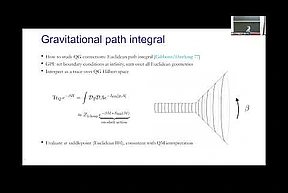
The one-loop gravitational path integral around Euclidean de
Sitter space S^D has a complex phase that casts doubt on
a state counting interpretation. Recently, it was proposed to
cancel this phase by including an observer. We explore this
proposal...
Over 50 years ago, Belinski-Khalatnikov-Lifshitz (BKL) argued
that the dynamics of spacetime close to a space like
singularity is chaotic and inhomogeneous. I will revisit the
BKL scenario within a modern understanding of quantum chaos
and...
The framework of quantum reference frames (QRFs) lies at the
crossroads of quantum information, gauge theory, quantum field
theory, and quantum gravity, and has seen rapid progress in recent
years. After introducing the perspective-neutral...