In a recent Scientific American article, a paper on zero-knowledge proofs by computational complexity theorist Rahul Ilango, Member in the School of Mathematics, was described as “the most creative and most consequential paper in the field [...] at least in the past decade.”
Theoretical computer scientist Ryan Williams returns to the Institute this fall as the architect of a proof described as “stunning” and “massive.” Ben Brudaker of Quanta Magazine interviewed him about the revolutionary result.
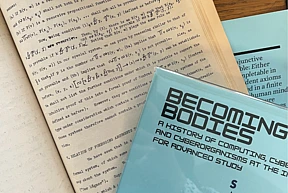
The rising prominence of artificial intelligence continues to blur the lines between human and machine. An exhibition currently on display at the Institute reveals that, since its founding, IAS has been a key space for the testing and contesting of these boundaries.
"By the time he was 17, Mark Braverman had lived in three countries and spoke as many languages. But though he doesn’t have a hometown, he’s quick to call theoretical computer science his home."