A New Season of Discovery: IAS Opens its Doors to 254 Visiting Scholars for 2026–27
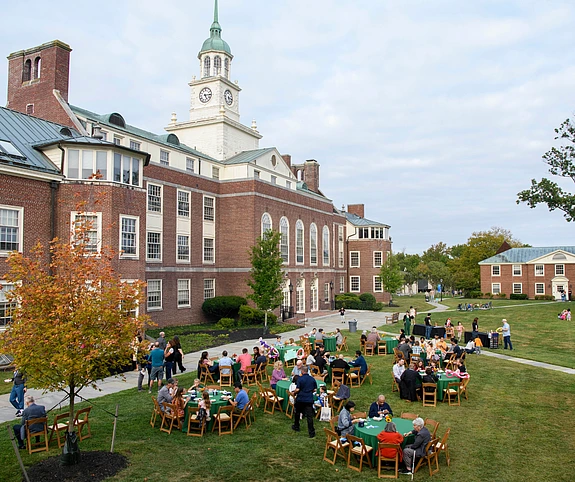
Kicking off its 2026–27 academic year on September 22, 2026, the Institute for Advanced Study is set to welcome 254 new and returning scholars from 43 nations and over 115 institutions. Selected by the Institute’s permanent Faculty for their outstanding work and potential for further discovery, these global scholars will pursue a wide variety of individual and collaborative endeavors. The incoming cohort features brilliant thinkers at all career stages, from postdocs to professors, who will work in tandem with the Institute's 23 permanent Faculty and 26 Emeriti—all renowned experts in their fields.
All scholars are based within one of the Institute’s four Schools—Historical Studies, Mathematics, Natural Sciences, and Social Science—or the Jonathan M. Nelson Center for Collaborative Research. The following four scholars represent a unique cross-section of this year’s class:
- Debjani Bhattacharyya, Robbert Dijkgraaf Member in the School of Historical Studies, is a historian of climate and political economy focusing on colonial South Asia.
- Christopher Beem, J. Robert Oppenheimer Visiting Professor in the School of Natural Sciences, is a theoretical physicist and mathematician who specializes in the study of quantum field theories.
- Yingyao Wang, Wolfensohn Family Member in the School of Social Science, is a sociologist who studies how political institutions and social networks shape economic development.
- Shuli Chen, Member in the School of Mathematics, works in geometric analysis, studying how curvature constrains the possible shape of space.
To learn about the remarkable breadth of scholarship at the Institute, visit our current scholar list, and watch videos from the Institute Instances series, which offer an opportunity to get to know more of the people who are, in the words of founding IAS Director Abraham Flexner, "pushing beyond the present limits of human knowledge."
In 2026–27, the Institute’s Schools of Social Science and Mathematics, as well as the Simons Center for Systems Biology within the School of Natural Sciences, will convene specialists to work on selected, year-specific topics.
The theme seminar of the School of Social Science is titled Emerging Forces in Global Political Economy. It will seek to better understand how societies navigate a changing political economy in which protectionism, resurgent national industrial policy, and growing corporate concentration in key sectors are shrinking the share of economic activity coordinated primarily by markets. The theme is led by Benjamin Braun, Visiting Professor (2026–28) in the School.
The School of Mathematics’s special year is focused on Conformally Symplectic Dynamics and Geometry. The goal of the program is to bring together experts in symplectic geometry, dynamics, partial differential equations, and applications, in order to exchange ideas between subfields. Michael Hutchings will serve as the special year’s Distinguished Visiting Professor.
With support from the Nelson Center for Collaborative Research, the Simons Center for Systems Biology is hosting a special year on Modeling Fly Vision, co-organized by Misha Tsodyks, C.V. Starr Professor in the School, and Visiting Professor (2026–27) Sebastian Seung. Recent scientific developments have made it possible to model the visual system of fruit flies with unprecedented realism. Building on this, the School’s program will explore the flies’ perception of motion, color, polarization, form, and objects, as well as complex visually guided behaviors such as navigation and courtship. This research initiative is one of twenty active Nelson Center projects.
The Institute is also currently accepting applications for the 2027–28 academic year.