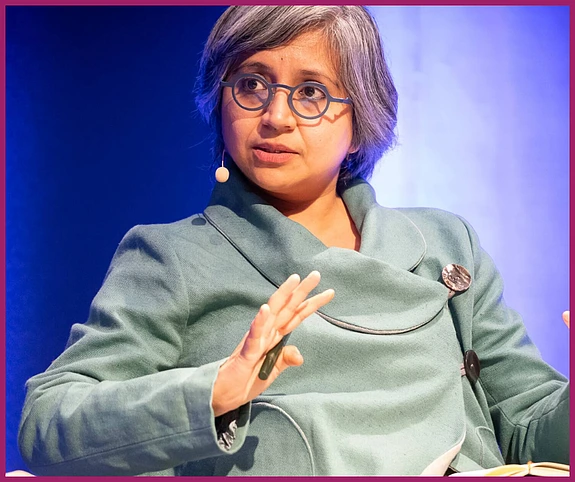
Debjani Bhattacharyya, Robbert Dijkgraaf Member in the School of Historical Studies, is a historian of environment and climate. Her work examines the relationship between weather and financial risk, drawing on sources from the eighteenth and nineteenth centuries. While at IAS, she will be working to complete her book, "Climate Futures Past: Insurance and Weather Knowledge in the Indian Ocean World." Bhattacharyya serves at the Chair for the History of the Anthropocene at the University of Zürich. She is the author of Empire and Ecology in the Bengal Delta: The Making of Calcutta, published by Cambridge University Press, which received an honorable mention for the Urban History Association's 2017–18 Best Book in Non–North American History Award.
What is your elevator pitch for describing your research?
Why have we turned to the market to solve the climate crisis? While social scientists point out that the financialization of climate politics began in the 1970s with the ascendancy of Earth system science, the mainstreaming of environmental movements, and economic futurology, my research points to a longer historical tradition of hedging and betting on weather risk. As a historian of environment and climate, I am interested in what we can learn by turning to eighteenth-century insurance archives, East India Company revenue archives, and actuarial debates about weather risk. Can late eighteenth-century bills of lading, premium charts, and underwriters' notes tell us something about how weather and financial risk were deeply entangled with one another? My goal is to get environmental and climate historians to pay close attention to these overlooked, rather dry, and scattered archives in order to understand the financial architecture that underwrote so much of early weather research. This year, the Polymarket in natural disasters has burst into mainstream news—but this is an older story, one I want to tell in my book.
Have any IAS scholars, past or present, influenced or impacted your research?
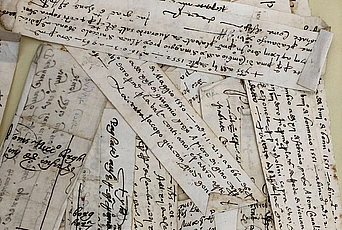
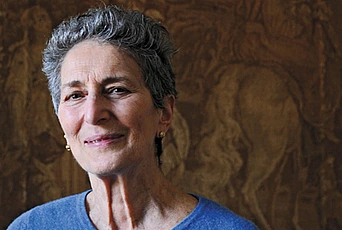
There are so many: Speaking of dry financial archives, I must admit that Francesca Trivellato, Andrew W. Mellon Professor in the School of Historical Studies, made studying insurance exciting. I am inspired by the rigor and creativity she brings to the study of this vast and sometimes unmanageable archive consisting often of small strips of paper—bills of exchange or promissory notes—and the way she makes them speak about the zeitgeist of the time. I doubt I would have ventured into the Lloyd’s archive had I not encountered her work and understood that what otherwise looked like a boilerplate insurance contract had something important to tell us about the financial cultures of the time. The ability of Natalie Zemon Davis, Member (1978) in the School of Social Science, to fish out the most arresting pieces from the archive and breathe life into these tricksters—all the while letting what she called the "voices of the past" keep her in check—is a craft to which I aspire. Finally, the efforts of Jairus Banaji, Member (2006–07) in the School of Historical Studies, to understand the role of capital, debt, and credit in South Asia is something I am constantly grappling with.
What changes or evolutions currently occurring within your field do you find most exciting?
Climate history is a rapidly burgeoning field, one I've found myself immersed in over the past few years. This was not the field I was trained in but something I began studying carefully after completing my first book. Historians of science are investigating the different kinds of actors and institutions engaged in producing climate knowledge, forecasting, and climate denialism—a very rich field. What is exciting, however, is that increasingly, scholars interested in finance, capitalism, speculation, assetization, the economy, and securitization are turning to the study of climate. When multiple disciplines begin to think about a puzzle from their own vantage points—and, more importantly, talk to one another—the debate moves forward. So suddenly scholars interested in energy, or dollarization, or ecology, or caste and race are coming together to think about the history of climate in ways we have not since we were talking about global versus globalization a few decades back.
What do you find to be the best part of your work day?
Always early morning—the first two hours after waking up. That is when I am most brutal with my writing, mercilessly butchering what I wrote the afternoon before. My most disciplined writing happens in those acts of deleting, until the half-formed thoughts and arguments from the day before begin to take shape. Unfortunately, I can only sustain that for a few hours in the morning.
Is there a word or term that you use in your research that most people wouldn’t know? What is it?
Underwriter is a word we both know, but not quite. I am often asked exactly who an underwriter is: is it a broker, a subscriber, or an insurance agent? It originates from a practice whereby merchants assuming the risks of the voyage would literally write their names under the shipping or maritime contracts outlining the amount of risk they would shoulder. The confusion surrounding this historical category emerges from the fact that it’s been around since the 1600s, evolving as maritime insurance contracts have evolved.

IAS has a long-standing tradition of afternoon tea. As an incoming IAS scholar, how do you drink your tea?
Always black and without sugar, lukewarm—otherwise you won't get the full taste of it—and I love my Darjeelings, Happy Valley if you will, with the morning newspaper, The Telegraph, Kolkata. This is exactly the opposite of how I drank my tea when I was in college in Kolkata: milky, piping hot, sugary, accompanied by a heated debate and, of course, from a bhar—a clay cup—and it was never a Darjeeling! The thing is, the best Darjeeling tea I've ever drunk is available in Zürich, which tells its own story about wealth and global supply chains.