In Memoriam: Chen Ning Yang 杨振宁 (1922–2025)
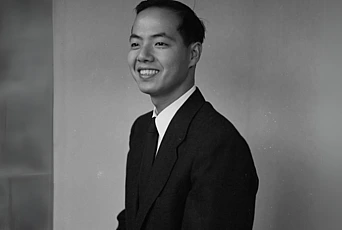
Chen Ning Yang (杨振宁), Faculty (1955–66) and Member (1949–54) in the Institute for Advanced Study’s School of Mathematics/Natural Sciences, passed away on October 18, 2025 at the age of 103.
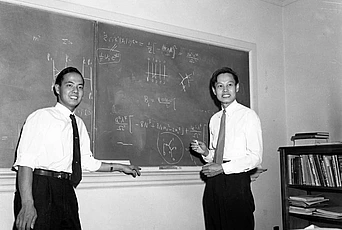
Throughout a career that reshaped modern theoretical physics, Yang combined bold physical insight with mathematical elegance. At the Institute, he produced a body of work whose influence runs through particle physics, statistical mechanics, and geometry. His ideas famously include the framework now known as Yang–Mills theory and—in partnership with Tsung-Dao Lee (李政道), Faculty (1960–62) and Member (1951–53, 1957–58) in the School of Mathematics/Natural Sciences—the demonstration that nature violates parity symmetry in weak interactions. These contributions redefined how scientists conceptualize the fundamental forces and symmetries of the universe.
Prior to Yang and Lee’s collaboration at IAS, most physicists assumed that the laws of physics were symmetric under spatial reflection, namely that a process and its mirror image should behave identically. Yang and Lee recognized that this principle of “parity conservation” had never been tested for weak nuclear interaction, which governs certain forms of radioactive decay. They proposed concrete experiments to probe this assumption. Chien-Shiung Wu (吳健雄) and her collaborators carried out the decisive tests, showing that weak processes do indeed distinguish left from right. The result overturned the thinking of the day and catalyzed a reconsideration of fundamental interactions, earning Yang and Lee the 1957 Nobel Prize in Physics. Wu’s contributions were honored in 1978 with the inaugural Wolf Prize.
Yang’s IAS years were also the crucible for another of the most important theoretical breakthroughs in twentieth century physics. In 1954, Yang and Robert L. Mills, Member (1955–56) in the School of Mathematics/Natural Sciences, introduced the mathematical framework that underlies non-Abelian gauge theories. With these theories, physicists are able to classify elementary particles—and understand their interactions—based on just a few simple symmetry principles. The Yang–Mills framework remains a cornerstone of modern physics, and underlies the Standard Model of particle physics, perhaps the most successful theory in the history of science.
Yang’s abilities and his contributions to scholarship were well recognized by his contemporaries at IAS. In 1953, the Institute’s then-Director J. Robert Oppenheimer wrote to the National Science Foundation—in support of Yang’s application for funds to travel to a conference in Japan—that Yang was “indeed one of the most brilliant young theorists in the world.” Oppenheimer continued: “As you know, two of the principal themes of the Conference are the physics of high energies and fundamental particles, and the physics of low temperatures, of liquid helium and of condensation. Dr. Yang is an expert in both of these, and his publications have aroused world-wide interest.”
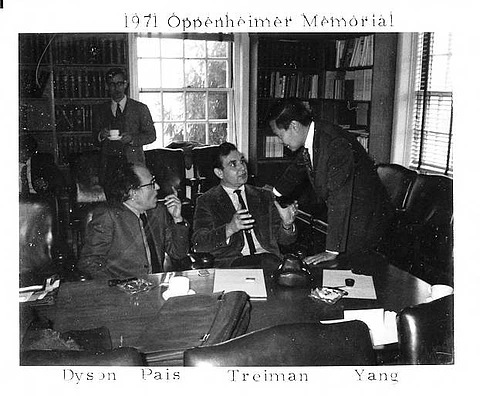
An earlier letter from Yang himself expresses his excitement, and his gratitude to Oppenheimer, for the opportunity to engage in curiosity-driven research at IAS. In a letter dated March 1, 1950, in which he formally accepts Oppenheimer’s offer of a five-year Membership, Yang wrote: “I feel greatly honored by this appointment, and I hope I shall be able to take full advantage of the excellent chance you have made possible for me to better myself as a physicist.”
Yang left IAS in 1966 in order to pursue a faculty position at Stony Brook University, where he was appointed as the Albert Einstein Professor of Physics, as well as the inaugural director of the organization’s Institute for Theoretical Physics, which is now named the C. N. Yang Institute for Theoretical Physics in his honor. Later in his career, he joined Tsinghua University, Beijing as a professor, where he established the university’s own Institute for Advanced Study.
Yang’s years at the Institute were undoubtedly integral to the formation of this institute. The Institute for Advanced Study, Tsinghua University explicitly describes itself as modeled after IAS, albeit in a university setting. Its goals, which Yang championed, are to “help establish a tradition of academic excellence in scientific research in China.” In nurturing this endeavor, Yang carried the Institute’s ethos across continents, seeding an enduring culture of independent inquiry and collaboration in China.
The legacy of Chen Ning Yang is felt throughout modern physics. For scholars at IAS and beyond, he exemplifies the courage to question assumptions and the discipline to build ideas that last.