On Tenacity, Tango, and the Formation of Stars: Q&A with Nadine Soliman
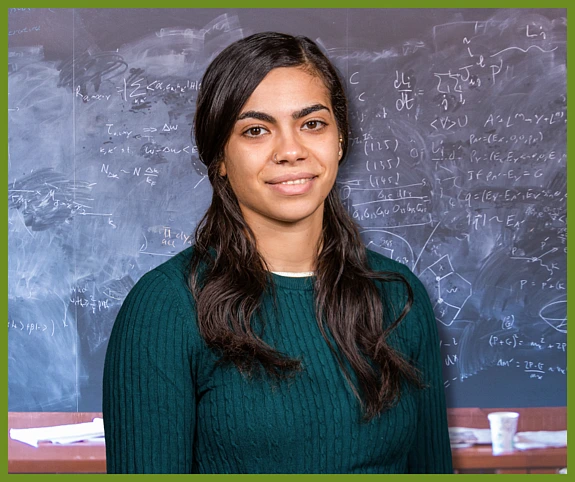
Nadine Soliman, NASA Hubble Fellow in the School of Natural Sciences, studies star and planet formation. At IAS, she’ll examine and simulate processes such as the collapse of molecular clouds, the birth of stellar clusters, and the formation of protoplanetary disks—all as case studies for larger questions about the interplay between microphysical processes and large-scale astrophysical structures. She received her Ph.D. at the California Institute of Technology.
What is your elevator pitch for describing your research?
My research focuses on how small-scale physics influences the evolution of large-scale astrophysical systems. I use simulations to study how local processes like thermochemistry, radiation, and magnetic fields affect the formation of planets, stars, and galaxies. The goal is to connect these scales and understand how microphysical processes shape the broader astrophysical environment.
Is there a childhood memory that still inspires the way you think or approach problems?
I played piano when I was young, and my teacher always reminded me that getting better wasn’t about talent, it was about putting in the time. That really stuck with me. Even now, when I’m facing a tough problem in my research, I remind myself that if I just keep working on it, I’ll eventually figure it out. It’s a comforting thought when things get challenging.
What will be the focus of your IAS Membership?
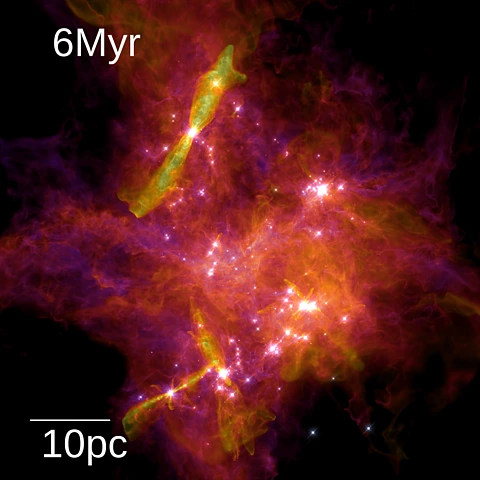
During my time at IAS, I will be studying how stars form and grow. Stars begin inside giant clouds of gas that collapse under gravity. As they form, a spinning disk begins to develop that continues to feed the star and eventually becomes the birthplace of planets.
Studying this process is challenging because many physical phenomena act simultaneously and interact in complex ways: gravity, turbulence, magnetic fields, and chemistry all play important roles. On top of that, stars launch fast jets and strong winds that regulate their growth, while the surrounding environment, including nearby stars, also plays a significant role in shaping the system’s evolution.
For a long time, simulations could only model parts of this process separately. Now, advances in computational methods allow us to combine these effects into a single, self-consistent model that connects the physics across different mechanisms and scales.
My work involves developing and running these simulations to explore questions such as: What determines the final properties of a star? How do the disks around stars form and evolve? And what are the conditions in which planets form?
What is the best part of your work day?
My walk over to my office. It is not quite home, not quite work: just some quiet time to think and ease into the rhythm of the day.
Have any IAS scholars, past or present, influenced or impacted your research?
Definitely! James Stone, Professor in the School of Natural Sciences, has had a big impact on my research. His expertise in numerical methods and star formation, along with his work across different areas of astrophysics, really resonates with what I’m doing. I am looking forward to working more closely with him at IAS and learning from his experience.
What was your dream job as a child?
When I was a kid, I really wanted to be an athlete. I loved taking something that seemed simple, breaking it into smaller skills, and practicing over and over to get a little better each time. It was a way of learning how my body worked and how to improve it. Even now, exercise is still one of the highlights of my day.
Is there a surprising job you have held outside of your research?
It wasn’t exactly a job, but I was president of the Tango Club during graduate school. I started with no dance experience and only went to a class my friend invited me to on a whim, but I quickly fell in love with it. Over the next few years, the club taught me everything I know about dancing, and soon enough, I was helping teach classes, organizing social dancing events, and even helped put together a three-day dance festival with a group of friends. It was a really fun experience and one of the best parts of my time at Caltech.
What is one thing from home you hope to bring to IAS?
Probably Turkish coffee, or the Egyptian variant that's often mixed with a bit of cardamom. I grew up with coffee being more about company than caffeine. Brewing it takes care and patience, and I love how it becomes a small ritual that brings people together.
Where is the most unusual place you have ever worked on your research?
Probably in quicksand, or quick mud, to be more accurate. I wasn’t exactly doing research, but during a class field trip to a mangrove forest to collect samples, I wandered into a patch of quick mud and sank up to my knees before getting pulled out. It wasn’t dangerous, but after that, I decided astrophysics simulations are much safer.
Do you have any superstitions when doing research/working/writing?
Not a superstition per se, but I need my slow mornings. After getting ready, I sit down with a quiet cup of tea before doing anything else. It doesn’t matter what kind, caffeinated or not, but if I skip it, the whole day feels off.
What is something memorable you read or watched this summer?
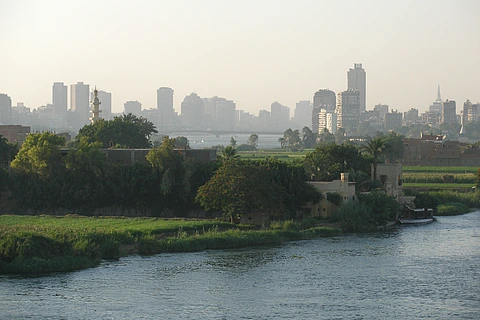
I read The Buried by Peter Hessler, a journalist who lived in Egypt for several years. The book blends stories about everyday life, politics, history, and archaeology, all drawn from his time in Cairo. I really enjoyed seeing my hometown through the eyes of someone who’s both an outsider and a thoughtful observer. He picks up on all these little things I’ve mostly stopped noticing or just see as normal. The book gives a really interesting look at how people relate to each other and navigate daily life in the city. It was a thoughtful and often surprising perspective on a familiar place.
If you had to give a seminar on something unrelated to your field, what would it be?
I’d love to give a seminar on tea. I attended one a while ago, and it completely changed how I think about tea. There’s so much to explore: the history, how tea is grown and processed in different regions, and how those factors shape its flavor. Tea can actually offer a far wider variety of flavors than most people expect. The seminars are usually hands-on, too. You get to brew, taste, and experiment while learning, which makes it way more engaging than a typical lecture. I love that tea connects culture, science, and history, and you really get to experience it with your senses instead of just hearing about it.