Einstein’s Ripples Realized: PiTP 2025 Investigates Gravitational Waves
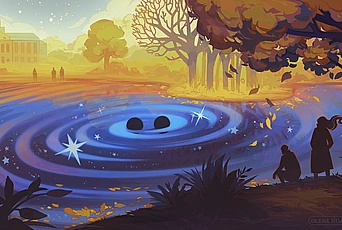
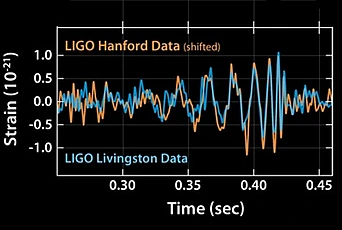
When massive objects like black holes or neutron stars move through the universe, they create ripples in the very fabric of spacetime. These are known as gravitational waves. Initially predicted in 1916 by founding IAS Professor (1933–55) Albert Einstein using his theory of general relativity, and detected for the first time just short of a century later in September 2015, these waves are capable of carrying with them information about some of the most mysterious events in the cosmos. They offer scientists a unique way to observe extreme astrophysical environments and primordial cosmological epochs.
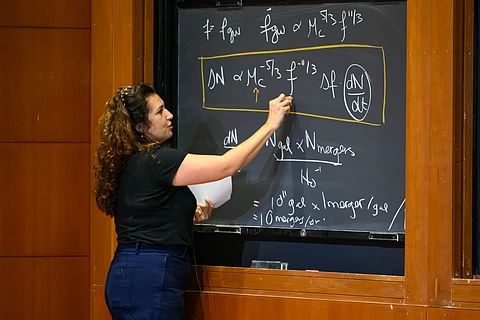
This summer, the Institute for Advanced Study became a hub for exploring this rapidly evolving field as the 2025 Prospects in Theoretical Physics (PiTP) program welcomed 85 advanced graduate students and postdoctoral scholars for an intensive two-week workshop focused on gravitational wave physics and astrophysics. Reflecting the truly global nature of the field, participants hailed from 27 countries and represented 52 institutions.
The 2025 PiTP program was designed to bridge the gap between theory and observation in this rapidly evolving field. Participants explored the latest advances in theoretical modeling, observational techniques, and data analysis, insights that will prove crucial once data begins to emerge from next-generation gravitational wave detectors like the Einstein Telescope and Cosmic Explorer, which will likely achieve a tenfold increase in detection sensitivity.
Key topics included waveform modeling, numerical relativity, gravitational wave searches, parameter estimation, pulsar timing arrays, and the astrophysics of gravitational wave sources. Lectures and discussions also focused on interpreting the wealth of data now streaming in from observatories around the globe, and on the challenges and opportunities that lie ahead.
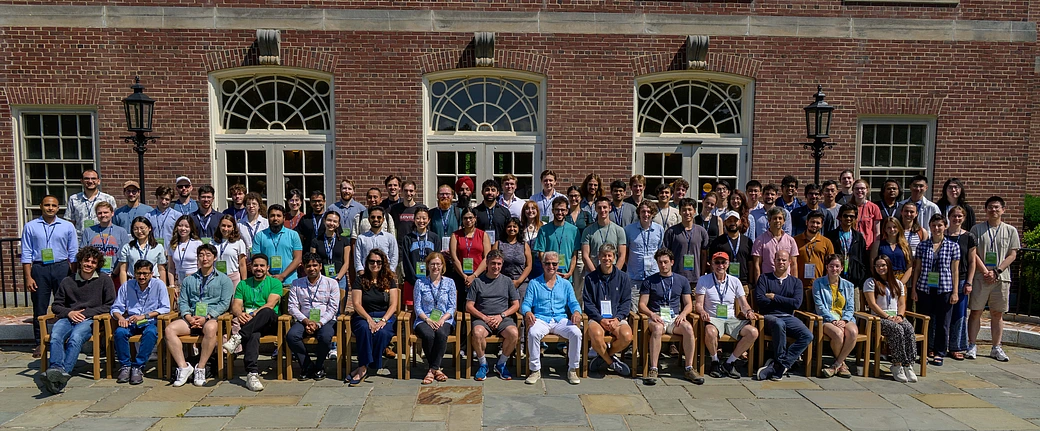
The program was organized by Maya Fishbach of the University of Toronto; Tejaswi Venumadhav Nerella, Member (2015–18) and John N. Bahcall Fellow (2018–20) in the School of Natural Sciences, now based at the University of California, Santa Barbara; Frans Pretorius, Visitor (2012–13) in the School, now based at Princeton University; Barak Zackay, Member (2017–22) in the School, now based at the Weizmann Institute of Science, Israel; and Richard Black Professor Matias Zaldarriaga. The roster of speakers featured leading experts from institutions worldwide, reflecting the collaborative and interdisciplinary spirit that defines gravitational wave research.
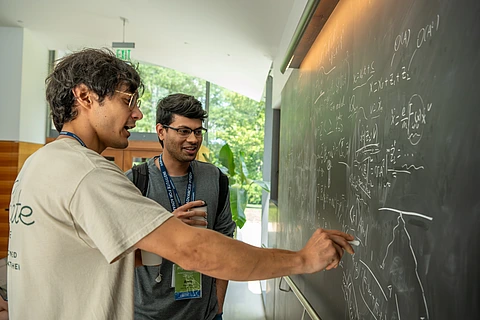
As with previous years, PiTP 2025 fostered a vibrant environment for learning and collaboration, not only advancing participants’ technical knowledge but building a community that will drive the next wave of discoveries in gravitational wave astrophysics.
Many of the lectures from the program are available to view via the PiTP 2025 IAS YouTube playlist.