Three 2026 Fields Medalists Highlight IAS’s Unique Research Environment
A recent article in Town Topics highlights a common bond between three of the four Fields Medal winners announced at the 2026 International Congress of Mathematicians: ties to the Institute for Advanced Study. Drawing on an interview with IAS Director and Leon Levy Professor David Nirenberg, the article goes on to emphasize the unparalleled research conditions at IAS that foster this level of excellence.
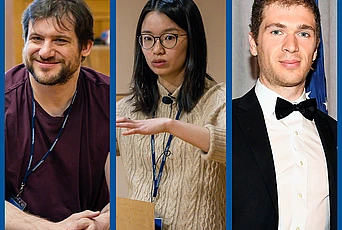
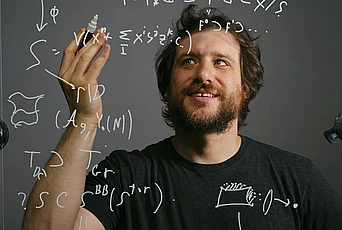
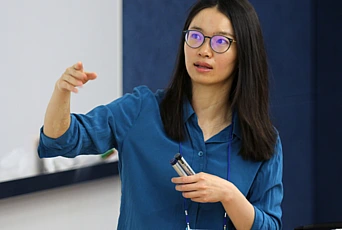
This year's Fields Medal laureates include Jacob Tsimerman, Ashvin B. Chhabra and Daniela Bonafede-Chhabra Member and Distinguished Visiting Professor (2025–26); Hong Wang, Member (2019–21); and John Pardon, Visitor (2016–17), all of whom are affiliated with the School of Mathematics. With these new additions, IAS scholars now account for 49 of the 68 Fields Medalists who have received this accolade in the award's history.
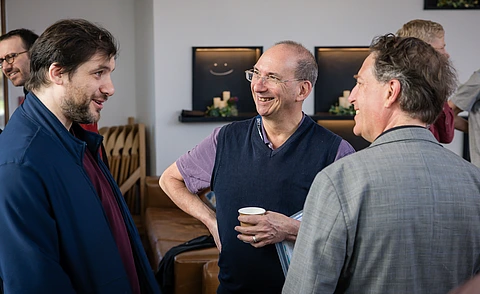
"The record is not simply the result of recruiting accomplished mathematicians, Nirenberg said. It reflects [the Institute's] longstanding mission of identifying exceptional talent from around the world and giving scholars the freedom to pursue their most ambitious questions." He added: "It’s hard to imagine what is better for catalyzing work than that kind of condition."
The piece also discusses the "special year" programs within the School of Mathematics, through which "IAS deliberately creates opportunities for mathematicians to tackle particularly significant problems." The School's 2025–26 special year on Arithmetic Geometry, Hodge Theory, and o-minimality was led by Tsimerman.
Nirenberg further notes that the Institute's long history of excellence, dating back to figures like founding Professor (1933–55) Albert Einstein, as well as Professor Emeritus Robert P. Langlands, creates a profound sense of motivation for current scholars, fulfilling the Institute's mission of ensuring "that there is a place in our society for that total commitment to the most difficult problems."
"The latest Fields Medals offer a particularly visible testament to that mission. But for IAS, the larger achievement may be the environment that makes such work possible: exceptional people brought together in one place, given the freedom to follow difficult questions wherever they lead, and surrounded by others doing the same."
Read the full article at Town Topics.