Hunting Down Guidance Laws
If you were to ask Hadleigh Frost, Member (2024–27) in the School of Natural Sciences, how he spends his Friday nights, his answer might surprise you.
Frost’s research interests lie in the realm of theoretical physics, in the mathematical problems that arise when computing scattering interactions between particles, but last winter, the data on his screen in the evening hours was very different. It tracked six African lions sprinting across a safari park enclosure in West Palm Beach, Florida.
The data came from Isla Duporge, an Associate Research Scholar in Princeton University's Department of Ecology and Evolutionary Biology and Lewis-Sigler Institute of Integrative Genomics. Duporge spent the previous spring and summer capturing high-definition drone footage of the lions in an experiment designed to mimic the final phase of a hunt. Her efforts produced a lot of data. To study these data, she reached out to Frost, who was happy to help. “I admire Isla’s data-driven approach to her work, so it was cool to be able to collaborate,” he said.
The resulting co-authored study, published in Current Biology in September 2026, offers new insight into a pressing question in animal behavior: How do lions control their steering and speed during the split-second, high-stakes final moments of a hunt?
Biologists have studied African lions for decades, but recording a hunt sequence in the wild is notoriously difficult: lions range widely, hunt mostly at night, and strike without warning. GPS collars and accelerometers can reveal how fast a lion is moving, but are not able to record where prey is relative to the lion. Without exact measurements of the motion of predator in relation to prey, scientists cannot study how a lion adjusts its motion in response to the prey. Doing so would require an experiment in which the motion of both could be observed together, from the start of a chase to its end.
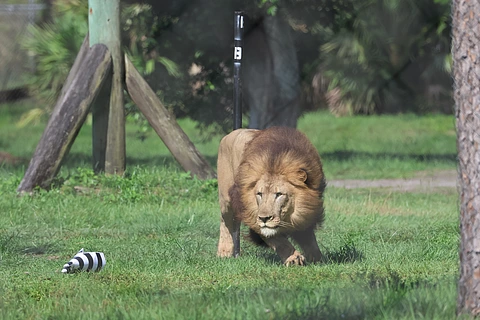
Duporge ran just such an experiment at Lion Country Safari in West Palm Beach, Florida, over four months. She recorded sixty-seven simulated hunts in which six lions chased faux prey, pulled by motorized lure boxes, across their large enclosure. The stars of the study, lionesses Mashika, Kya, and Zuri, and lions Atlas, Masaba, and Kwasi, were rewarded for successful capture with pieces of meat. Duporge ran the trials in the early morning, before the park opened. “The lions took to the experiment with little coaxing,” she said, and the lion keepers welcomed the chases as enrichment for the animals.
The lure followed fourteen distinct, zig-zagging routes across the enclosure, preventing the big cats from memorizing the trajectory. Flying a drone overhead at seventy meters to avoid disturbing the animals, Duporge captured high-definition video footage of the chases.
To extract the animals’ movements from tens of thousands of video frames, Duporge applied an artificial intelligence pose-tracking program called SLEAP (Social LEAP Estimates Animal Poses), developed at Princeton University in the Shaevitz Lab. By tracking key points on the lion and the lure, and re-projecting the footage into real-world coordinates using GPS control points, she reconstructed each chase as a precise trajectory.
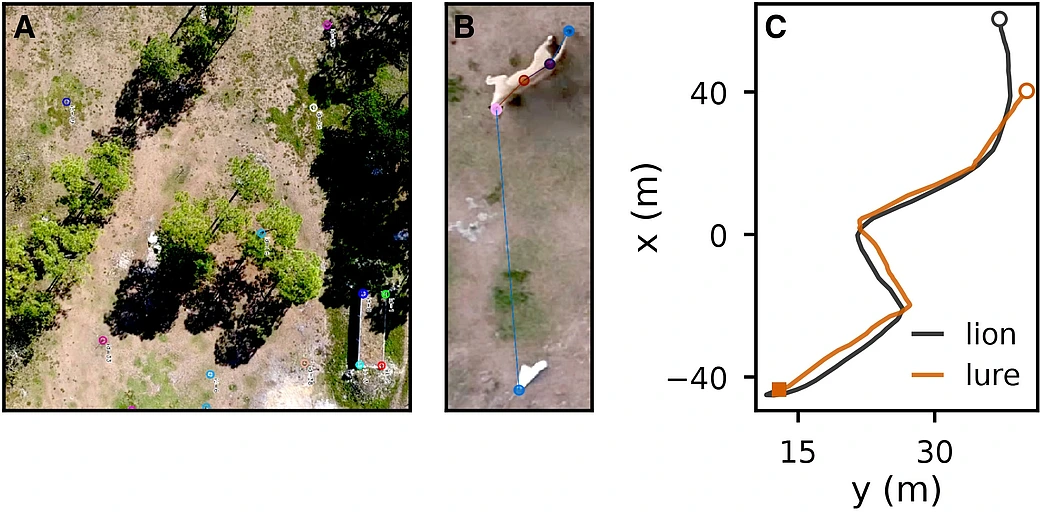
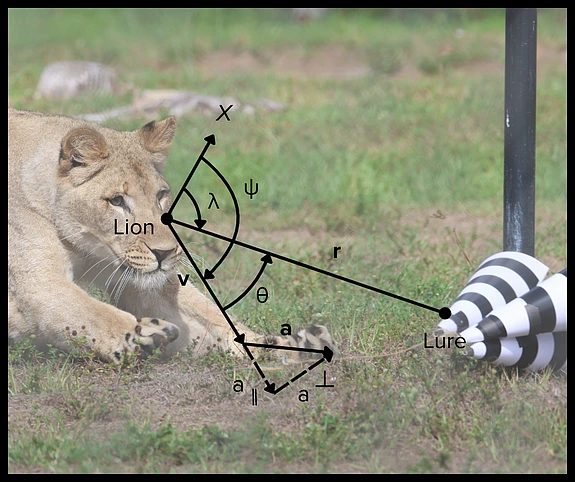
Next, Frost stepped in. He used the trajectories reconstructed from the SLEAP tracking to work out, moment by moment, how fast each lion was running, which way it was heading, and how quickly it was turning. With this dataset, he set out to test whether classical guidance laws, known from exploring the movements of other animal species, could describe lion steering.
Guidance laws are the mathematics of interception. Engineers developed them to steer homing missiles, but over the past two decades biologists have found the same rules at work in nature. Two of these mathematical rules are “proportional pursuit” and “proportional navigation.”
Imagine you’re trying to meet a friend who is walking across a field. One strategy is to always walk straight toward where your friend is right now, re-aiming as they move. Scientists call this “proportional pursuit.” Another, more efficient strategy is to watch which way your friend seems to be drifting and aim ahead of them. This is “proportional navigation.”
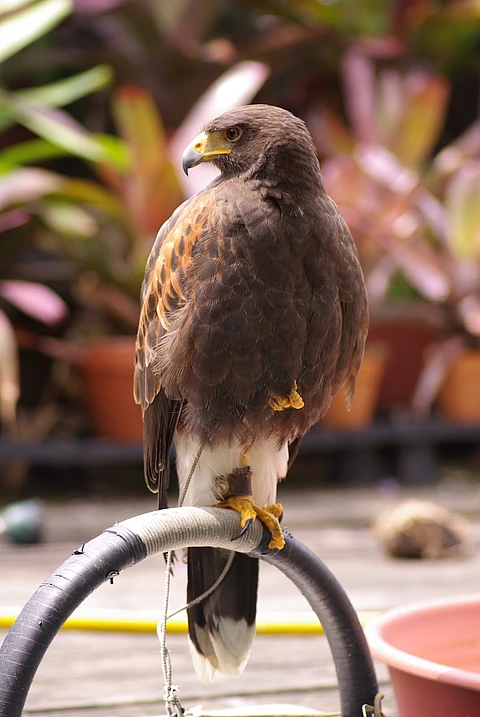
Proportional navigation is efficient when a target’s path can be predicted, while proportional pursuit demands less of a pursuer’s senses and is harder for a sudden swerve to exploit. Harris’s hawks, which hunt agile, unpredictable prey, blend the two in what is known as a “mixed guidance law.” Such a mixed guidance law had previously been identified only in these aerial predators. Until now.
Frost’s analysis showed that across the sixty-seven chases, the same mixed guidance law gave the most convincing account of how lions steer to keep themselves aimed towards the lure.
Frost confirmed this by use of computer simulations. For each chase, he simulated a digital lion, giving it the real lure’s movements and the real lion’s speed, and let the guidance law control how it steered. The two trajectories were closely aligned.
That a heavy, land-bound carnivore uses the same steering logic as a bird maneuvering in three-dimensional airspace might seem extraordinary. But not to Frost. “You would expect an equation of this sort to be a reasonable approximation,” he stated, but he didn’t expect it to fit quite this well. “That birds operate in three dimensions and lions in two didn’t make much qualitative difference,” he added.
Duporge said that their findings around the mixed guidance law were also the subject of conversation among her biologist colleagues. She recalled being asked whether the same guidance law might apply to lions and Harris’s hawks because both species are cooperative hunters. But she is careful not to over-interpret the resemblance. Demonstrating the result for only two species, far apart in their taxonomy, she stressed the need for more data before speculating on evolutionary explanations. “We don't know what precise attack strategies exist across the animal kingdom,” she said, “and so we can’t describe well how they are clustered taxonomically.”
The study does, however, provide a valuable demonstration of how such data can now be readily collected using new technology. Until recently, Duporge explained, there was no practical way to pull information about an animal’s changing posture and position from video footage. AI-based pose-estimation of the quality needed for this kind of study is only a decade old and very few studies have applied this technique to large animals outdoors. To study dynamics of animals outdoors, researchers largely rely on accelerometer collars, which cannot show where prey is in relation to predator. Now, the approach demonstrated in Duporge and Frost’s paper can be repeated on other species, without the need to sedate and collar an animal. “You can set up quickly in the field and record animals on the move non-invasively,” she said. Duporge is eager to test the findings against wild hunts and to validate the method further by comparing to data obtained through accelerometer collars.
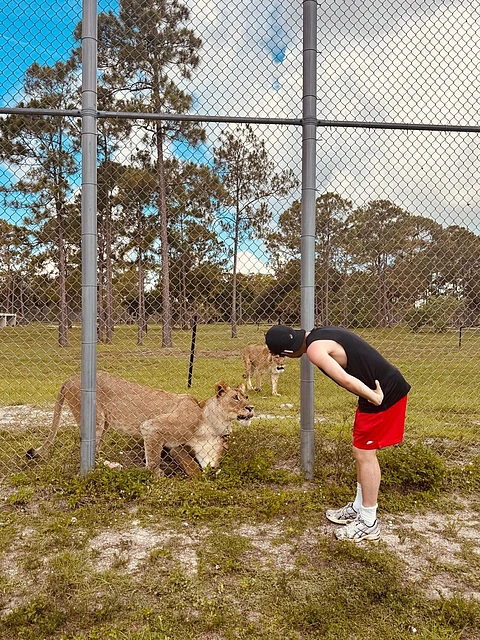
For Frost, applying skills from theoretical physics to the project was good fun! “If you have training in physics, then at some point in your life you’ve had the experience of playing with data,” he explained. “And I enjoyed playing with this.” “It’s always very satisfying to find simple mathematical explanations for phenomena,” he added. If that wasn’t enough, as a further source of satisfaction, Frost even had the opportunity to visit the project to see the lions in action!
As Frost and Duporge’s collaboration shows, IAS physics isn’t exclusively reserved for quiet contemplation at campus blackboards. Sometimes, as it turns out, it runs wild at a safari park.