John von Neumann

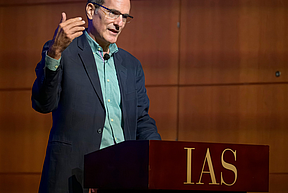
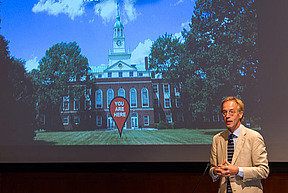
In welcome remarks delivered to the 2025–26 class of IAS scholars, Director and Leon Levy Professor David Nirenberg reflected on the Institute’s role as "a special place" dedicated to discovery. He emphasized how the Institute's history, culture of solitude and community, and spirit of dialogue create an environment where scholars can push the boundaries of knowledge.

In the cognitive revolution, psychologists, recognizing that developments in information processing had potential for studying the human mind, sought for the first time to apply new ideas in early artificial intelligence, computer science, and neuroscience to psychology. The Institute, as the home of one of the first modern computers, was uniquely poised to serve as a hub for this nascent field of study.

In 1930, the Institute was created as an academic retreat for the pursuit of daring research, unfettered by material constraints. From the beginning, political turmoil around the world interfered with this dream. This exhibit traces key moments in this history, focusing on questions of displacement and academic freedom in Europe, the United States, and Latin America from the 1930s to the 1970s. 

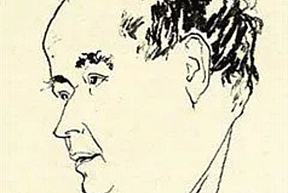
The following excerpt is from the article “Can We Survive Technology?” by John von Neumann, published by Fortune magazine in 1955. Von Neumann was among the Institute’s first Professors and its youngest. Having pioneered the modern computer, game theory, nuclear deterrence, and more, von Neumann illuminated the fields of pure and applied mathematics, computer science, physics, and economics.