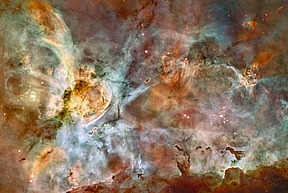
Stargazers know all too well the challenges of observing the
night sky on a cloudy evening. Fortunately, waiting a night or two
can help to resolve the issue. But what happens if these clouds are
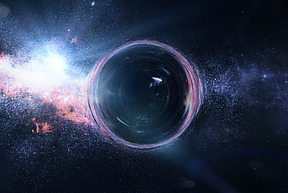
light years away and lie seemingly dormant in the...
The Carl P. Feinberg Cross-Disciplinary Program in Innovation at
the Institute for Advanced Study will unite today’s boldest ideas
in physics, mathematics, and beyond to unlock new and fascinating
truths about the natural world. Endowed in...
It is well known that the expansion of the universe is
accelerating due to a mysterious dark energy. Within galaxies,
stars also experience an acceleration, though this is due to some
combination of dark matter and the stellar density. In a new...
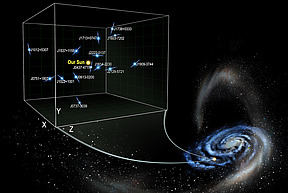
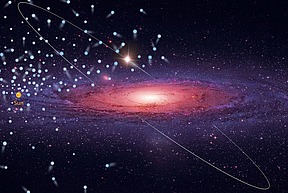
"Within our galaxy, there are thousands of stars that orbit the
center of the Milky Way at high velocities. On occasion, some of
them pick up so much speed that they break free of our galaxy and
become intergalactic objects. Because of the extreme...
"...Freeman
Dyson had a lot of stories. One of my favorites was about how
he decided to turn from studying mathematics to studying physics.
As he told me in his “Math Life” interview, he was walking down the
King’s Parade in Cambridge with a friend...
By Sara
Seager, Member (1999–2002) in the School of Natural
Sciences
"At its essence, astrophysics is the study of light. We know
that there are stars other than the sun because we can see them
shining. But light doesn’t just illuminate. Light...
By Kristen R.
Ghodsee, Member (2006–07) in the School of Social Science:
"For Dyson, the mysteries of human behavior were just as deep
and enduring as the mysteries of the universe. In the sheer breadth
of his interests, Dyson embodied the ideal of...
When particle physicists try to model experiments, they confront
an impossible calculation — an infinitely long equation that lies
beyond the reach of modern mathematics. But threerecentpapers from a group of physicists led by
Sebastian
Mizera...
The 2020 Shaw Prize in Astronomy has been awarded to Roger Blandford, Member (1974–75,
1998) in the School of Natural Sciences. Blandford is recognized
“for his foundational contributions to theoretical astrophysics,
especially concerning the...