“Flexner and Dijkgraaf argue that basic research—driven by
curiosity, freedom and imagination—is a proven and essential seed
for the revolutionary technologies that fuel the economy, transform
society, and provide solutions for the world’s problems...
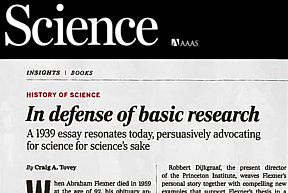
Craig A. Tovey of Science Magazine reviews The
Usefulness of Useless Knowledge (Princeton University Press,
March 2017) by founding IAS Director Abraham Flexner with a companion essay by
current IAS Director Robbert
Dijkgraaf. The book, Tovey writes...
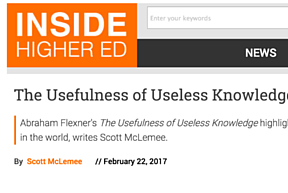
Scott McLemme of Inside Higher Ed reviews The
Usefulness of Useless Knowledge (Princeton University Press,
March 2017) by founding IAS Director Abraham Flexner with a
companion essay by current IAS Director Robbert Dijkgraaf. Of the
book, McLemme...
Jonathan Israel, Professor Emeritus in the School of Historical Studies, has been awarded the 2017 Comenius Prize by the Foundation of the Comenius Museum in the Netherlands.
In 1934, David Hilbert, by then a grand old man of German
mathematics, was dining with Bernhard Rust, the Nazi minister of
education. Rust asked, “How is mathematics at Göttingen, now that
it is free from the Jewish influence?” Hilbert replied,...
The following is a letter sent by Robbert Dijkgraaf, Director and Leon Levy Professor, to the Institute Board of Trustees, Faculty and Emeriti, and Staff, on January 30, 2017.
On December 2, Robbert
Dijkgraaf, Director and Leon Levy Professor, will discuss the
wonders of light as part of his sixth live lecture for the DWDD
University series. “From the big bang to the rainbow, the magic of
light connects us with everything...
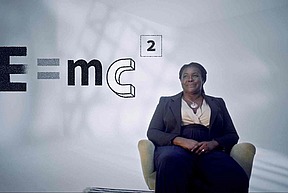
“Beauty is the torch you hold up in the belief that it will lead
you to truth in the end," said Sir Michael Atiyah, former Professor in the
School of Mathematics. With E=mc2, Albert Einstein built a bridge between
energy and mass, two concepts that...
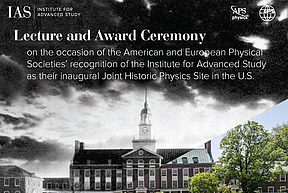
The Institute for Advanced Study, one of the
world’s foremost centers for curiosity-driven basic research, will
be recognized by the American Physical Society
(APS) and the European Physical Society (EPS) as
their first Joint Historic Physics Site...
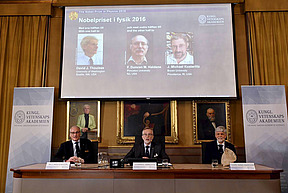
A trio of British-born researchers working in the U.S. won the Nobel Prize in Physics Tuesday for what one of them called a curious mathematical “toy” that to his surprise revolutionized the study of exotic matter suitable for quantum computers, new superconductors, and advanced designer materials.