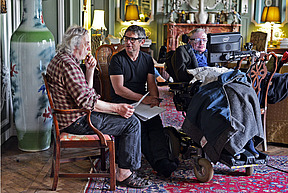
New calculations by Stephen Hawking and former Members in the
School of Natural Sciences Malcom
Perry and Andrew
Strominger suggest that essential properties of whatever falls
into these cosmic pits may survive. Read more http://ow.ly/fqf13011cVL.
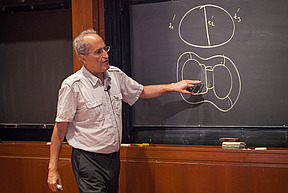
Edward Witten, Charles Simonyi Professor in the School of
Natural Sciences, has been awarded the Albert Einstein World Award
of Science 2016 from the World Cultural Council. Witten received this
award for his visionary research across physics and...
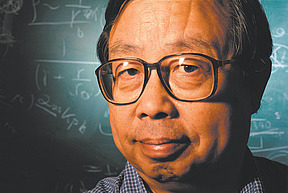
Freeman Dyson, Professor Emeritus
in the School of Natural Sciences, examines The Most Wanted Man
in China: My Journey from Scientist to Enemy of the State by
Fang Lizhi, in The New York
Review of Books. Lizhi, a Member in the School of
Natural...
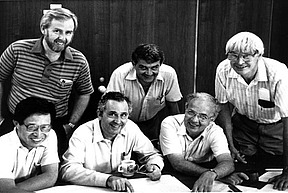
Neta Bahcall, Member
(1982–83) in the School of Natural Sciences, discusses the
forty-year effort of John
Bahcall, Richard Black Professor in the School from 1971 until
his death in 2005, to predict the rate of neutrinos from the Sun.
Watch the talk...
In Black Hole Blues: And Other Songs From Outer Space
the astrophysicist and novelist Janna Levin chronicles the
decades-long development of a machine that could detect
gravitational waves—a quest marked by the highest degree of human
intelligence...
The story of how and why the universe began is written in the
sky. Cosmologists believe that details of the Big Bang are encoded
in triangles and other shapes that appear in the distribution of
galaxies. Lately, they’ve made significant progress in...
Ars Technica's John Timmer describes a talk given by
chemist Russel Hemley as part of Dreams of Earth
and Sky, a program held at the Institute on the occassion of
Professor Emeritus Freeman Dyson's
ninetieth birthday, writing "Hemley focuses on...
As a postdoc at Rutgers University, I attended a physics
colloquium presented by Sergei Kapitza in the fall of 1992.
His talk argued that human population growth is hyperbolic
with a singularity in the year 2026. Actually, this claim was
first...
Abstract: Ensembles of randomly wired
networks, constrained by biology (cell types, Dale’s law,
geometry), can rival far more detailed models in matching
statistics of neural population dynamics, thus revealing the
“typical” behavior of high...