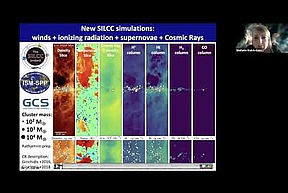
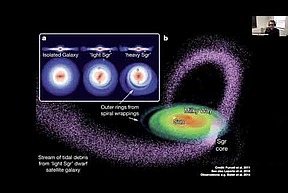
Star formation takes place in the densest and coldest parts of
the interstellar medium (ISM), in dark molecular clouds. These are
swept up by multiple supernova explosions on scales of several
hundred parsec. While condensing out of the warm ISM...
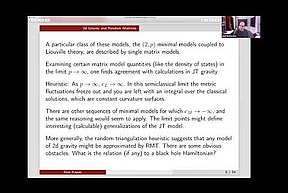
I will revisit the
quantum field theory of the Coulomb gas formalism, clarifying
several important points along the way. The first key ingredient
involves a peculiarity of the timelike linear dilaton: although the
background charge Q breaks the...
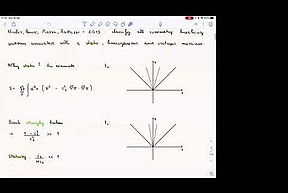
I discuss graviton non-Gaussianities in models of inflation
where de Sitter isometries are spontaneously broken. First, I
review the different symmetry breaking patterns following Nicolis,
Penco, Piazza, Rattazzi (2015), and discuss which of them...
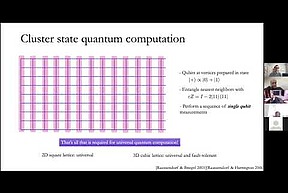
With gate error rates in multiple technologies now below the
threshold required for fault-tolerant quantum computation, the
major remaining obstacle to useful quantum computation is scaling,
a challenge greatly amplified by the huge overhead imposed...
The Milky Way is a unique testbed for theories of galaxy
formation and evolution. Especially the stellar halo is amenable to
studies into our galaxy’s past both because it contains some of the
oldest stars and because the dynamical timescales are...
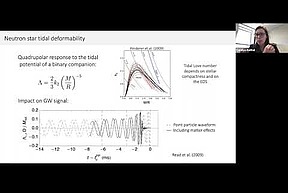
Binary neutron star mergers provide a unique probe of the
neutron star equation of state (EOS) across a wide range of
parameter space, from the zero-temperature EOS during the inspiral
to the finite-temperature EOS following the merger. In this
talk...
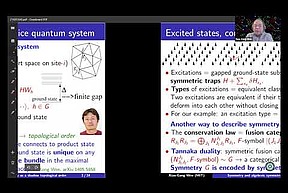
A symmetry is usually described by transformations and an
associated group. However, a symmetry can also be described by
the conservation of charges, encoded by their fusion rule. This
leads to a description of symmetry based on fusion category...
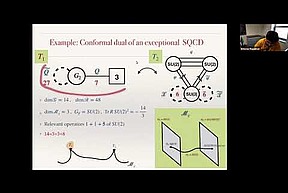
We will discuss a geometric re-interpretation of N=1 SQCD
with special unitary gauge groups. We will argue that the 4d
SU(M) SQCD in the middle of the conformal window can be
engineered by compactifying certain 6d SCFTs on three punctured
spheres. ...
We will discuss the geometry behind the horizon of various
asymptotically AdS black holes when the boundary CFT is deformed by
a scalar operator. The dynamics of classical GR in the region
inside the black hole turns out to be rather intricate, with...
Reconstruction of bulk operators within the causal wedge is
simple to achieve using Lorentzian causal bulk dynamics. In
contrast, the only known methods for reconstructing arbitrary
operators in the full entanglement wedge (the Petz map,
modular...