In this talk I will overview two very different kinds of random
simplicial complex, both of which could be considered
higher-dimensional generalizations of the Erdos-Renyi random graph,
and discuss what is known and not known about the expected...
We give a pseudorandom generator, with seed length $O(log n)$,
for $CC0[p]$, the class of constant-depth circuits with unbounded
fan-in $MODp$ gates, for prime $p$. More accurately, the seed
length of our generator is $O(log n)$ for any constant...
I will introduce l-adic representations and what it means for
them to be automorphic, talk about potential automorphy as an
alternative to automorphy, explain what can currently be proved
(but not how) and discuss what seem to me the important open...
I will describe the proof of the following surprising result:
the typical billiard paths form the family of the most uniformly
distributed curves in the unit square. I will justify this vague
claim with a precise statement. As a byproduct, we...
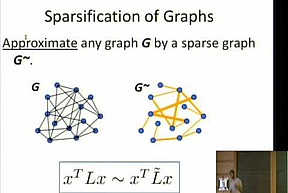
I will discuss the problem of approximating a given positive
semidefinite matrix A , written as a sum of outer products $vv^T$ ,
by a much shorter weighted sum in the same outer products. I will
then mention an application to sparsification of...