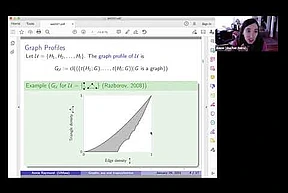
Establishing inequalities among graph densities is a central
pursuit in extremal graph theory. One way to certify the
nonnegativity of a graph density expression is to write it as a sum
of squares or as a rational sum of squares. In this talk, we...
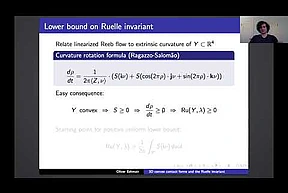
Is every dynamically convex contact form on the three sphere
convex? In this talk I will explain why the answer to this question
is no. The strategy is to derive a lower bound on the Ruelle
invariant of convex contact forms and construct dynamically...
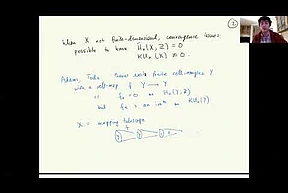
In this talk I will present my work initiating the study of
the C0C0 symplectic mapping class group, i.e. the group
of isotopy classes of symplectic homeomorphisms, and briefly
present the proofs of the first results regarding the topology of
the...
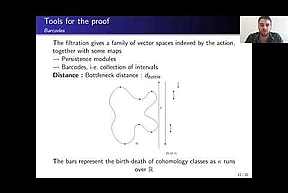
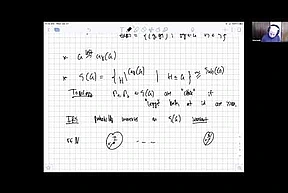
I will describe how basic ergodic theory can be used to prove
that certain amenable groups are stable. I will demonstrate our
method by showing that lamplighter groups are stable. Another
uncountably infinite family to which our method applies are...
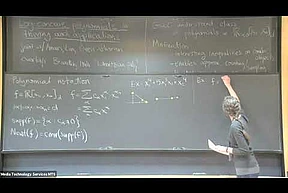
A polynomial with nonnegative coefficients is strongly
log-concave if it and all of its derivatives are log-concave as
functions on the positive orthant. This rich class of polynomials
includes many interesting examples, such as homogeneous real...