Informally, a quantum cellular automaton (QCA) describes some
discrete-time local dynamics of a quantum system. Formally, a
QCA is a *-automoprhism of the algebra of local operators.
Local quantum circuits provide one example of QCA, but the...
Powerful techniques have been developed in quantum field theory
that employ algebras of local operators, yet local operators cannot
create physical charged states in gauge theory or physical
nonzero-energy states in perturbative quantum gravity. ...
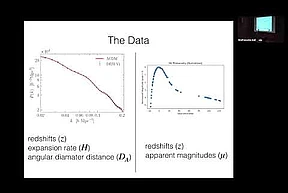
The so-called galaxy--halo connection is a vast topic concerning
how galaxies populate their host dark matter halos. I will
present some works we have made under this grand theme, including
(1) the detection of assembly bias signal with the help of...
AI progress is accelerating, and now the leaders expect
“artificial general intelligence” (AGI) in 2 to 3 years. While
difficult to believe, we must prepare for the possibility. We can
take some lessons from previous episodes in which computers...
Despite the undeniable success of the Large Hadron Collider
(LHC), Beyond the Standard Model (BSM) physics remains elusive. In
this talk, I will outline a multifaceted strategy to maximize
discovery potential at current and future high-energy...
The first structures of particle dark matter form by
gravitationally condensing out of the smooth mass distribution of
the early universe. This formation mechanism leaves these "prompt
cusps" with uniquely compact r^-1.5 density profiles and
links...
Neutron stars born with magnetic fields greater than 1014 G
(“magnetars”) are common in the Galaxy. Approximately 10 - 50% of
the young neutron star population possesses such field strengths.
These objects exhibit very slow rotation, spectacular...
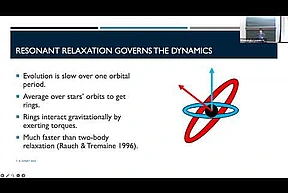
Stars orbiting sufficiently close to massive black holes
inevitably inspiral towards the black hole due to gravitational
wave radiation. The fate of such stars is subtle and depends on an
interplay between tidal heating of the star, mass transfer...
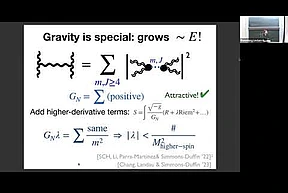
On-shell methods have found a new application to local
observables such as asymptotic radiation fields and gravitational
waveforms. While these observables are invariant under small gauge
transformations, they are known to depend on a choice of...