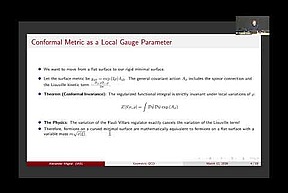
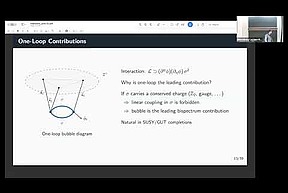
The $\epsilon$-expansion is a widely used technique to study
aspects of renormalization group flows and critical phenomena. In
this talk, I will discuss recent developments of the
$\epsilon$-expansion in the study of boundary and defect...
Cold Neptunes appear to be among the most abundant planets in
the Galaxy, yet their role in shaping planetary systems remains
poorly understood. We study the dynamical evolution of cold Neptune
systems born in resonant chains through disk-driven...
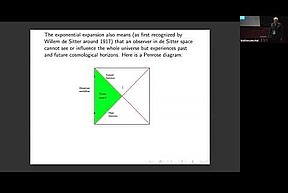
Cosmological data has opened up new vistas on fundamental
physics yet it is limited in its scope. While it has given us
tantalizing hints at how the Universe might be expanding, it is
unclear whether it can ever be used to find the
microphysical...
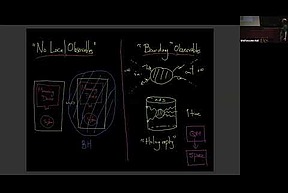
In a spacetime with asymptotically anti-de-Sitter boundaries,
localized bulk events produce characteristic signals at boundary
locations that are lightlike from the event. I will describe
(thought) experiments that use boundary wavepackets to...
Discs of stars around super-massive black holes, like the one at
the Galactic centre, evolve primarily via resonant relaxation,
which is the process governing the evolution of the
angular-momentum vectors of stellar orbits about the
super-massive...