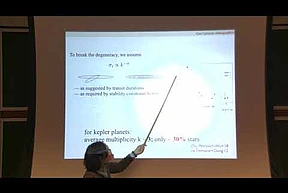
A large number of close-in super-Earths have now been
discovered. These planets are most likely formed while the
proto-planetary disks are still alive, hence the title of this
talk. I will report some recent observational results, regarding
their...
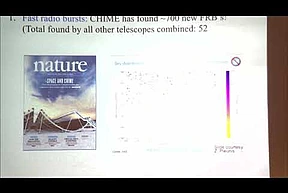
CHIME is a new interferometric telescope at radio frequencies
400-800 MHz. The mapping speed (or total statistical power) of
CHIME is among the largest of any radio telescope in the world, and
the technology powering CHIME could be used to build...
New and improved observational facilities are sampling the night
sky with unprecedented temporal cadence and sensitivity across the
electromagnetic spectrum. This exercise led to the discovery of new
types of astronomical transients and...
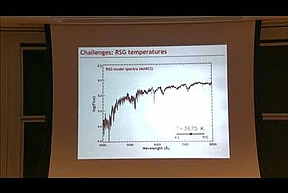
Red supergiants (RSGs) are the helium-fusing descendants of
moderately massive (10-25Mo) stars. As the coldest and largest (in
physical size) members of the massive star population, these
evolved stars serve as ideal "magnifying glasses" for...
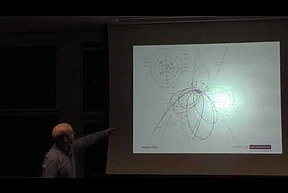
Several lines of evidence, both theoretical and observational,
indicate that additional planets in the outer solar system remain
to be discovered. Most recently, attention has been focused on
'Planet Nine',a few Earth mass planet with a moderate...
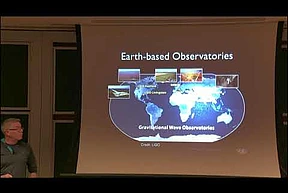
The observation of mergers of black holes and neutron stars has
established gravitational-wave astronomy as powerful tool to
understand the Universe. After a brief introduction to
gravitational waves and how the detectors work, I will discuss
the...
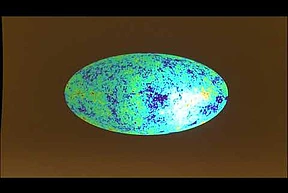
The cosmic microwave background (CMB) research told us a
remarkable story: the structure we see in our Universe such as
galaxies, stars, planets, and eventually ourselves originated from
tiny quantum fluctuations generated in the early Universe...
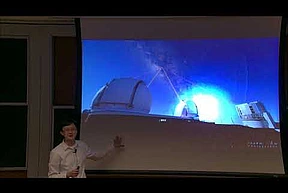
The center of the Milky Way hosts the closest supermassive black
hole and nuclear star cluster to the Earth, offering us the
opportunity to study the physics of supermassive black holes and
their environment at a level of detail not possible...
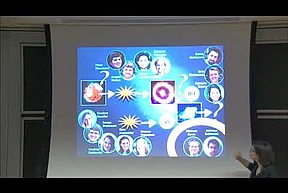
From the first networks of organic reactions in the Hadean to
the molecular complexity of life today, evolution encountered many
hurdles, corresponding to transition points from a proto-metabolism
to polymers, from polymers to networks capable of...