Black Holes

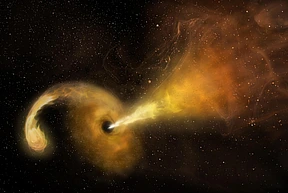
An international collaboration co-led by Andrew Mummery, Martin A. and Helen Chooljian Member (2025–30) in the School of Natural Sciences, has uncovered a universal rule governing one of the most powerful astronomical events in the universe. The scholars have shown that black holes—whether they are “stellar-mass” objects ten times the mass of our sun or supermassive giants millions of times heavier—fire powerful jets of material at the same juncture in their feeding cycles.

An international collaboration co-led by Andrew Mummery, Martin A. and Helen Chooljian Member (2025–30) in the School of Natural Sciences, has uncovered a universal rule governing one of the most powerful astronomical events in the universe. The team has shown that black holes—whether they are “stellar-mass” objects ten times the mass of our sun or supermassive giants millions of times heavier—fire powerful jets of material at the same juncture in their feeding cycles.

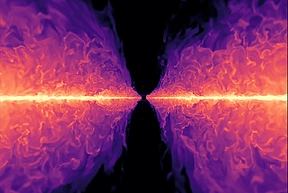
Building on decades of effort, Lizhong Zhang, Member (2023–24) in the School of Natural Sciences; James Stone, Professor in the School; and a team of astrophysicists have achieved a major milestone: developing the most comprehensive model to date of luminous black hole accretion. Their breakthrough allows scholars to "observe" such black hole systems not through a telescope, but through a computer.

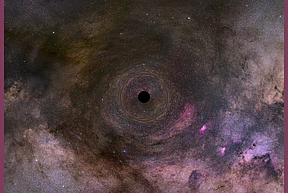
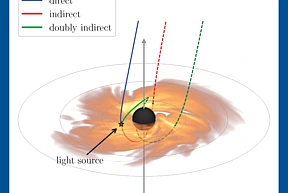
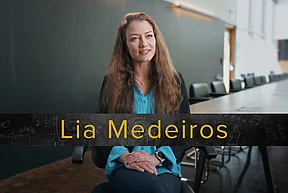
Frank and Peggy Taplin Member George N. Wong, Visitor Lia Medeiros, and Professor James Stone, all from the Institute's School of Natural Sciences, have developed an innovative technique to search for black hole light echoes. Their novel method, which will make it easier for the mass and the spin of black holes to be measured, represents a major step forward, since it operates independently of many of the other ways in which scientists have probed these parameters in the past.