Computation and Biology Explored at Theoretical Physics Program at Institute for Advanced Study
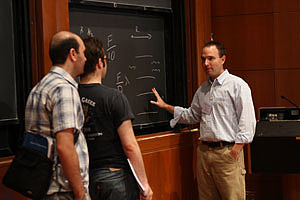
The 2012 Prospects in Theoretical Physics program will gather graduate students and postdoctoral scholars from around the world to the Institute for Advanced Study July 9 to 20 to explore “Computation and Biology.” This will mark the eleventh anniversary of the annual summer program and the first time it has addressed topics at the interface of theoretical computer science, statistical physics and quantitative biology.
“The program plays to one of the strengths of the Institute, which is to take an integrated view of science and, in this case, explore exciting new links between biology, physics and computing,” said Bernard Chazelle, Eugene Higgins Professor of Computer Science at Princeton University, who will lecture at the program and is one of its organizers. Prospects in Theoretical Physics builds on the strong relationship of the research groups at the Institute and Princeton University, and faculty members from both institutions are involved in the program.
The intensive two-week residential program is intended for graduate students and postdoctoral scholars from any of three fields: computer science, theoretical physics and quantitative biology. More than 80 participants from some 10 countries, including the United States, will attend lecture series on viruses and immunity, errors and codes, natural algorithms, growth and form, and learning and robotics. In addition to lectures, participants will work through related problems in daily homework and discussion sessions.
Prospects in Theoretical Physics, first held at the Institute in 2002, seeks to help the physics community train the next generation of scholars in various areas of theoretical physics. In past years the program has covered a range of topics including cosmology, supersymmetry, astrophysics and the physics of the Large Hadron Collider. A special effort is made to reach out to women and minorities, along with graduate students in small universities who typically do not have the same opportunities and access to leaders in the field as graduate students in large research institutions.
Prospects in Theoretical Physics 2012 is organized by Stanislas Leibler, a Professor in the Simons Center for Systems Biology in the Institute’s School of Natural Sciences, together with Bernard Chazelle and David Huse of Princeton University. Other lecturers are Arnold J. Levine, Professor Emeritus at the Institute; Tsvi Tlusty, Member at the Institute; Guillaume Bonfante of the Université de Nancy; Arup Chakraborty of the Massachusetts Institute of Technology; Enrico Coen of the John Innes Centre, Norwich; Jean-Louis Deneubourg of the Université Libre de Bruxelles; Måns Ehrenberg of Uppsala University; Dario Floreano of the École Polytechnique Fédérale de Lausanne; Hod Lipson of Cornell University; Przemyslaw Prusinkiewicz of the University of Calgary; and Guy Theraulaz of the Université Paul Sabatier, Toulouse.
Additional information may be found at www.sns.ias.edu/pitp.
About the Institute for Advanced Study
The Institute for Advanced Study is one of the world’s leading centers for theoretical research and intellectual inquiry. The Institute exists to encourage and support curiosity-driven research in the sciences and humanities—the original, often speculative thinking that produces advances in knowledge that change the way we understand the world. Work at the Institute takes place in four Schools: Historical Studies, Mathematics, Natural Sciences and Social Science. It provides for the mentoring of scholars by a permanent Faculty of approximately 30, and it ensures the freedom to undertake research that will make significant contributions in any of the broad range of fields in the sciences and humanities studied at the Institute.
The Institute, founded in 1930, is a private, independent academic institution located in Princeton, New Jersey. Its more than 6,000 former Members hold positions of intellectual and scientific leadership throughout the academic world. Thirty-three Nobel Laureates and 40 out of 56 Fields Medalists, as well as many winners of the Wolf and MacArthur prizes, have been affiliated with the Institute.