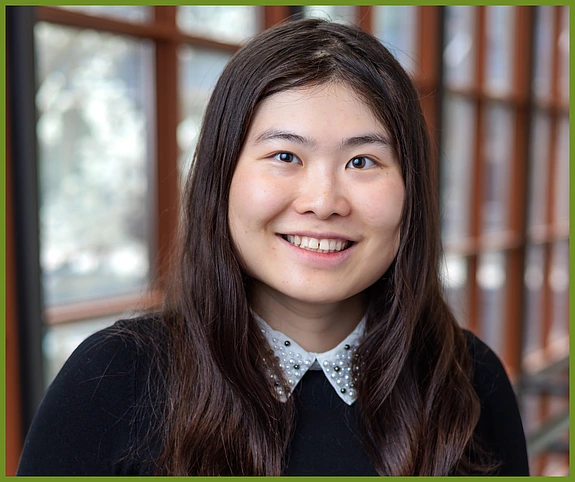
Shuli Chen, Member in the School of Mathematics, works in geometric analysis, studying how curvature constrains the possible shape of space. She comes to IAS from the University of Chicago, where she served as the L.E. Dickson Instructor in the Department of Mathematics from 2025–26. Prior to UChicago, she earned her Ph.D. at Stanford University under Otis Chodosh, Veblen Research Instructor (2016–19) in the School of Mathematics. Chen also received a Bachelor of Arts degree from Cornell University in 2018.
What is your elevator pitch for describing your research?
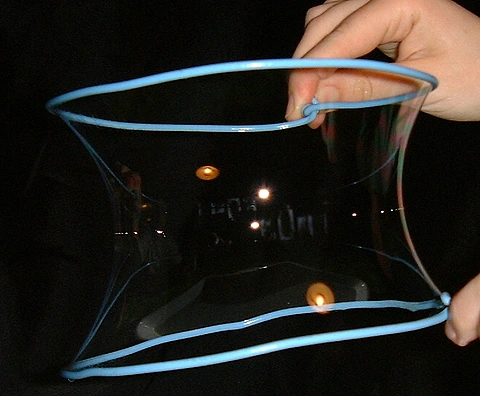
I study how curvature constrains the possible shape of space. I am particularly interested in positive scalar curvature, a notion that also appears naturally in general relativity, where the curvature of space is related to the distribution of matter and energy. One of my main tools is a generalization of soap films called minimal surfaces, which can act as probes of the surrounding space and detect when certain geometries are impossible.
Have any IAS scholars, past or present, influenced or impacted your research?
Definitely! Richard Schoen, frequent Member in the School of Mathematics, and Shing-Tung Yau, Professor (1980–84) in the School, have both had a major influence on my research. Their pioneering work using minimal surfaces to study scalar curvature is fundamental to my field, and I see my own research as continuing along the path they opened.
What changes or evolutions currently occurring within your field do you find most exciting?
I find the rapid development of AI the most exciting and, at the same time, intimidating. It feels as though every day there is another headline about AI making progress on mathematical problems. This makes me wonder what the role of mathematicians will become and, on a more personal level, where my own place will be in mathematics. This development reminds me of Ken Liu's short science-fiction story "Music of the Spheres," which I first read in high school. The ending left a deep impression on me when I first read the story, and it resonates with me even more now. In the story, the protagonist loves mathematics from childhood and dreams of making it his profession, but new cognitive technology eventually allows other mathematicians to think in ways that he physically cannot. He ends up teaching mathematics to children and passing on the excitement that drew him to it in the first place.
Is there a personal connection between your journey as a researcher and the subject you study?
My mom's workplace was near a planetarium, so I went there often when I was little. I was fascinated by the universe and even applied (unsuccessfully) to be a volunteer guide there during high school. My dad also loves science fiction, so our home was full of science-fiction books and magazines. For a while, I thought I might become an astronomer. That never happened, but I ended up studying scalar curvature, which has deep connections to general relativity. In some sense, I am indeed studying the universe that fascinated me as a child.
Is there a childhood memory that still inspires the way you think or approach problems?
I don't know if this counts as "childhood," but I have a vivid memory from high school. I was asking my deskmate for help with a math problem. He patiently explained it to me and then asked whether I understood. I said yes, and he replied, "Then explain it back to me." I got stuck almost immediately and realized that I had not understood it nearly as well as I thought. That experience stayed with me. It taught me that being able to follow an argument is very different from truly understanding it, and that one of the best tests of understanding is whether you can explain the idea yourself.
What is something you can easily lose track of time doing?
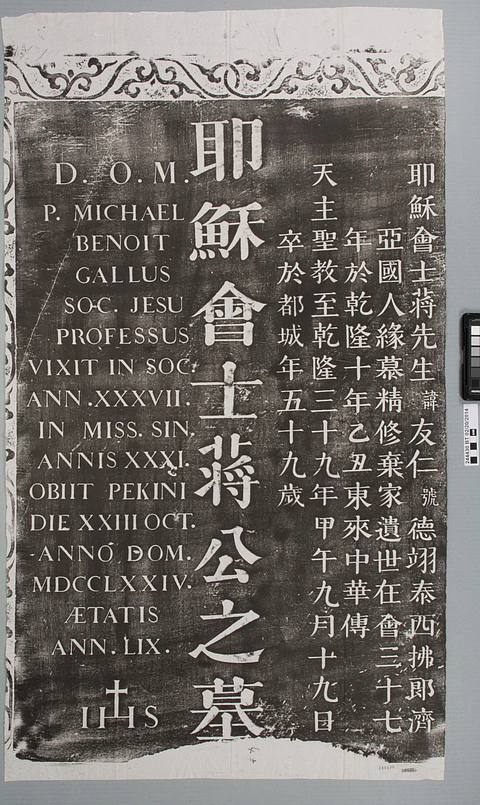
Historical detective work. When some small detail catches my attention during a visit, in something I read, or in a conversation, I usually cannot resist looking into the history behind it. It might be an old map, a name, a tombstone, or a building, and then I start following the clues. I also love detective stories, so perhaps the appeal is similar. I started doing this more seriously during the pandemic and at first relied almost entirely on electronic sources. I was amazed by how much is available online. More recently, I've also had the pleasure of visiting archives and museum collections in person.
One example is a project I started on old missionary tombstones in my hometown of Beijing, whose unusual calligraphy sparked my interest during a museum visit. Tracing their history led me through books, maps, blogs, databases, and archival records. Quite by coincidence, I discovered that a large collection of rubbings made in the early 1900s from those tombstones had ended up in the Field Museum in Chicago, near where I was living at the time. I was especially excited to eventually visit the museum collections and archives myself. Along the way, I also found that those rubbings were originally made for the American Museum of Natural History in New York City, so perhaps that will be the next stop now that I'm in Princeton.
Do you have any items on your bucket list to complete while you are in Princeton?
I would say owning a car. I've had a driver's license for years but have never owned a car, so I feel I've somehow missed part of the "American experience." Princeton may finally be the place where I start to own a car and drive regularly, and I'm curious to see what kind of new routines and possibilities that brings.
IAS has a long-standing tradition of afternoon tea. As an incoming IAS scholar, how do you drink your tea?
I started drinking tea young because my parents drink it regularly, but I am not much of a tea connoisseur. I usually prefer black tea or fruit tea, anything that is not too bitter. During my Ph.D., I really enjoyed the daily afternoon tea time with friends, especially with fresh snacks like fruit. Graduate students took turns buying and preparing the tea each day, so the snacks depended a lot on who was on duty, and that variety was part of the fun. I find fresh fruit particularly nice in the afternoon, and for me tea time is as much about taking a pleasant break and talking with people as it is about the tea itself.