Algorithmic Game Theorist Tim Roughgarden Appointed to IAS Faculty
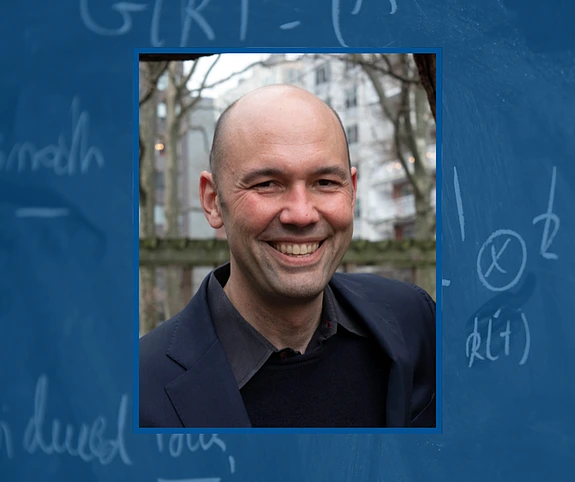
Tim Roughgarden, a world-renowned authority in the field of algorithmic game theory (AGT), has joined the Institute for Advanced Study as a Professor in the School of Mathematics, effective July 1, 2026. Roughgarden comes to IAS from Columbia University, where he served as a Professor in the Computer Science Department.
“Tim is a founding figure in the field of algorithmic game theory. He is known not only for the clarity, depth, and influence of his work, but also for his capacity to synthesize emerging problems in the field for the wider research community,” said David Nirenberg, IAS Director and Leon Levy Professor. “His appointment resonates with a rich Institute history in game theory that stretches from the foundational work of John von Neumann to that of Nobel laureate Eric Maskin, even as his work extends that field in important new directions.”
Roughgarden’s arrival complements the current expertise within the School of Mathematics. Complexity theory and the theory of algorithms have long been two of the most central and well-developed areas within theoretical computer science. Roughgarden has worked widely across the field of algorithms. His research and expository writing have shaped the area of “beyond worst-case analysis,” which develops novel frameworks for rigorous algorithmic performance guarantees in applications where traditional worst-case analysis is overly pessimistic or misleading. With complexity theory currently advanced in the School by Avi Wigderson, Herbert H. Maass Professor, and Irit Dinur, Betsey Lombard Overdeck Theory of Computing Professor, the addition of Roughgarden establishes the theory of algorithms as another pillar of strength at IAS.
Dinur described herself as being “thrilled” to welcome Roughgarden to the Institute. “He is an intellectual leader in algorithms and optimization, strengthening a core area of theoretical computer science in our School,” she said.
She continued: “Tim is a theory builder. Beyond his aforementioned pioneering work in AGT, in recent years his work has laid the foundations for modeling the messy world of decentralized computation, including blockchain systems. He is known for opening up entirely new research directions and setting the agenda for others to follow. His work has built bridges between economics and computer science, and between theory and practice. I look forward to seeing what new connections he forges at IAS.”
Algorithmic game theory is a field at the intersection of theoretical computer science and economics. Many problems central to modern computer science, ranging from resource allocation in large networks to the design of blockchain protocols, fundamentally involve interactions among multiple self-interested parties, and their analysis requires tools from economics and game theory. Conversely, several fundamental notions from theoretical computer science, such as approximation and complexity, now play an important role in contemporary economic theory. Roughgarden’s work is widely regarded as field-defining. His research with Éva Tardos (Cornell University) on “selfish routing,” recognized with the 2012 Gödel Prize, analyzed how uncoordinated, self-interested behavior in networks—such as drivers choosing routes or Internet traffic competing for capacity—can reduce system efficiency, and proved tight bounds on this loss, known as the “price of anarchy”.
“I’ve long admired IAS and its commitment to fundamental inquiry and intellectual leadership,” stated Roughgarden, adding that it is “a tremendous honor” to join the Faculty. “I’m particularly excited to contribute to the growth of theoretical computer science at the Institute, and to further advance the field’s connections with economic theory and strengthen its central role in modern computing applications.”
Prior to joining IAS, Roughgarden spent seven years on the computer science faculty at Columbia University, following 15 years on the computer science faculty at Stanford University. Earlier in his career, he earned his Ph.D. from Cornell University and completed postdoctoral positions at Cornell and UC Berkeley. He is the recipient of multiple prestigious awards and honors, including the ACM Grace Murray Hopper Award in 2009 and the Kalai Prize in Game Theory and Computer Science in 2016. He was named a Fellow of the Game Theory Society in 2019 and a Fellow of the Association for Computing Machinery in 2023, and was elected to the American Academy of Arts and Sciences in 2026.
He has written or edited numerous books and monographs, including Twenty Lectures on Algorithmic Game Theory (Cambridge University Press, 2016), Beyond the Worst-Case Analysis of Algorithms (Cambridge University Press, 2021), and the Algorithms Illuminated series (Soundlikeyourself Publishing, 2017–2022).
About the Institute
The Institute for Advanced Study has served as one of the leading independent centers for theoretical research and intellectual inquiry since its establishment in 1930, advancing the frontiers of knowledge across the sciences and humanities. From founding IAS Faculty Albert Einstein, Erwin Panofsky, and John von Neumann to influential figures Emmy Noether, George Kennan, and J. Robert Oppenheimer to the foremost thinkers of the present, IAS is dedicated to enabling independent inquiry and fundamental discovery.
Each year, the Institute welcomes more than 250 of the world’s most promising post-doctoral researchers and scholars who are selected and mentored by a permanent Faculty, all of whom are preeminent leaders in their fields. Among present and past Faculty and Members, there have been 37 Nobel Laureates, 46 of the 64 Fields Medalists, and 25 of the 29 Abel Prize Laureates, as well as winners of the Turing Award; the Pulitzer Prize in History; the Wolf, Holberg, and Kluge prizes; and many MacArthur and Guggenheim fellows, among other honors.