WAM 2026 Makes Waves Exploring KdV and Fourier Restriction Theory
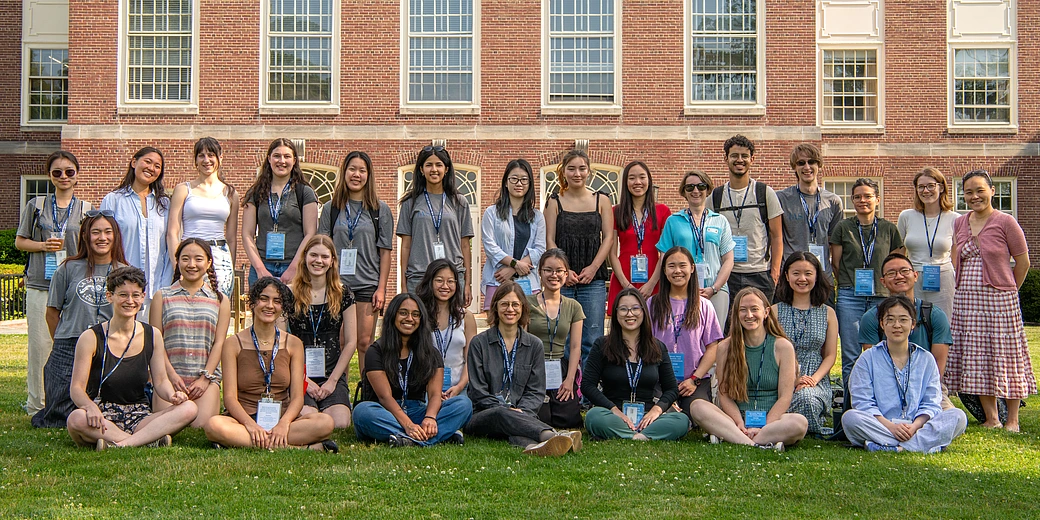
The annual WAM program took place at the Institute for Advanced Study from May 17–22, 2026, uniting 35 students, educators, and researchers for a weeklong mathematical workshop. This program aims to foster academic connection and nurture emerging mathematicians of exceptional talent and promise at all career stages.
This year’s theme, “Waves, Wave Packets, and Their Interactions,” was brought to life through two lecture courses, daily lightning talks, joint problem-solving sessions, and group meals.
The centerpiece of WAM consists of the Terng and Uhlenbeck lectures, named for Chuu-Lian Terng, Member (1979, 1997–98) in the School of Mathematics, and Distinguished Visiting Professor Karen Uhlenbeck. These scholars were not only innovators in their respective mathematical fields but were also integral in the establishment of the WAM program at IAS in 1994.
For the 2026 program, the Terng lecture course was taught by Dominique Maldague of Cambridge University and the University of California, Los Angeles, and teaching assistant Olivine Silier of the University of California, Berkeley. Maldague’s course discussed Fourier series, mathematical tools used to solve equations that describe waves and quantum systems—such as the wave and Schrödinger equations—and Fourier restriction theory, which studies what happens when the frequencies allowed in these series are limited. In the course, this theory prompted the exploration of a more geometric approach to understanding functions and how they apply to topics of prime numbers, arithmetic progressions, and the Kakeya problem in fractal geometry. The Terng lectures are available to watch on the Institute’s YouTube channel.
The Uhlenbeck lectures, delivered by Monica Visan, Member (2006–08) in the School of Mathematics, and teaching assistant Katie Marsden, both of the University of California, Los Angeles, used the Korteweg–de Vries (KdV) equation to study the behavior of waves. The KdV equation is a dispersive partial differential equation that mathematically models waves that spread out over time. This course covered topics including dispersion, well-posedness (i.e., whether solutions to the equations exist and behave predictably), and solitons (namely waves that keep their shape while traveling), and introduced the idea of a “Lax pair,” which helps to explain the complete integrability of this model.
The 2026 program was organized by Wei Ho, WAM Director and Visiting Professor in the School of Mathematics, who also holds appointments at Princeton University and the University of Michigan. The organization of the event was also supported by the Program Committee.
Founded in 1993 at the Park City Mathematics Institute with the aim of supporting women in mathematics, WAM was established at IAS the following year under the leadership of Uhlenbeck and Terng, with support from then-Director Phillip Griffiths. Since then, the program has been dedicated to building and fostering a successful living and learning environment for the emerging mathematical community. WAM is open to all who support its mission. In 2019, the program was recognized for its impact with the American Mathematical Society’s “Mathematics Programs that Make a Difference” Award.
WAM receives generous support from the Institute for Advanced Study, Lisa Simonyi, the Minerva Research Foundation, the Robert S. Hillas Fund, Jane Street, the Gerard B. Lambert Foundation, and the Princeton University Department of Mathematics.