Rashid Sunyaev Honored with Fritz Zwicky Prize for Astrophysics & Cosmology
The European Astronomical Society has announced that Rashid Sunyaev, Maureen and John Hendricks Distinguished Visiting Professor (2010–22) and Distinguished Visiting Professor (2022–24) in the School of Natural Sciences, is the winner of the 2026 Fritz Zwicky Prize for Astrophysics and Cosmology. Sunyaev, who is based at the Max-Planck-Institut für Astrophysik in Germany, was cited for "his pioneering work on the cosmic microwave background and the theory of disk accretion."
The citation further mentions his "many seminal results," including "the 'standard' theory of disk accretion onto black holes and neutron stars, the Sunyaev-Titarchuk formula [...], and the Sunyaev-Zel’dovich prediction," which was announced in 1970.
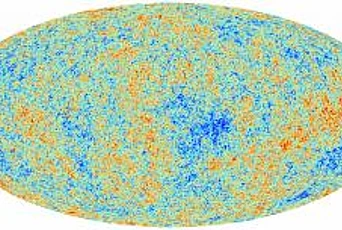
The landmark 1970 prediction theorized that primordial sound waves rippling through the hot, dense early universe would leave a permanent imprint on the cosmos. Sunyaev, alongside his colleague Yakov Zel’dovich, proposed that these waves would create tiny brightness fluctuations in the cosmic microwave background. Furthermore, they predicted the existence of concentrated regions of dense gas created by these same ripples, which would dictate where galaxies would eventually form. Today, astronomers can observe the predicted spacing between vast numbers of galaxies, confirming Sunyaev's pioneering framework.
Sunyaev is also praised for his work on experimental X-ray and gamma-ray astronomy, "where he had many important discoveries." The citation continues: "He was one of the scientific leaders of the observatories MIR/KVANT, GRANAT, INTEGRAL, and SRG, which led to important scientific results in high-energy astrophysics." INTEGRAL, the first space observatory with the capacity to see celestial objects simultaneously in gamma rays, X-rays, and visible light, made significant contributions to astrophysical knowledge. In particular, it helped to identify the sources of some of the gravitational waves and ultrahigh-energy neutrinos detected by specialized instruments on the ground.
Read the full citation for the 2026 Fritz Zwicky Prize for Astrophysics and Cosmology on the European Astronomical Society website.