Knot Your Average Summer Program: PCMI 2026 Explores Knotted Surfaces in Four-Manifolds
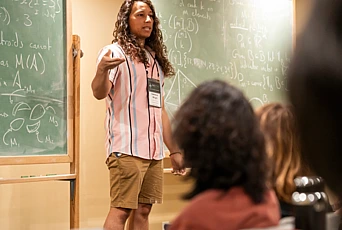
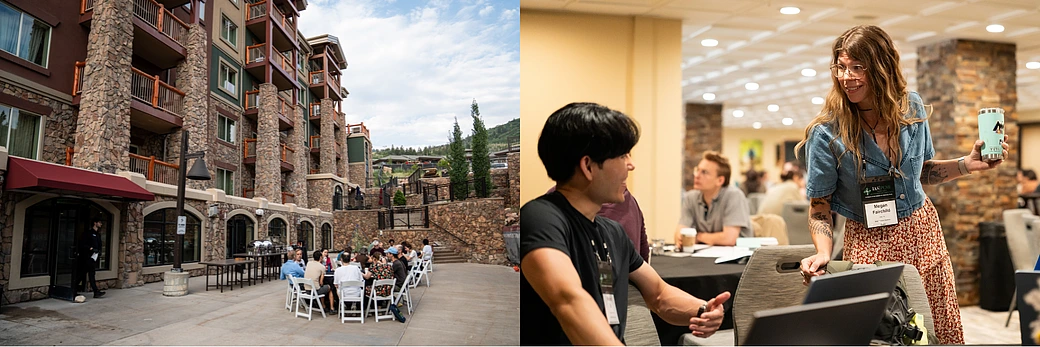
Welcoming 252 participants from 18 countries around the world, the 2026 Park City Mathematics Institute (PCMI) once again transformed Park City, Utah, into a thriving nexus for mathematical discovery. PCMI is an annual outreach initiative of the Institute for Advanced Study. Over the course of three intensive weeks, between June 28 and July 18, its attendees focused on the topic of knotted surfaces in four-manifolds.
Just as a one-dimensional string can tie into a knot in three-dimensional space, a two-dimensional surface—like a sphere or torus—can twist into a knot inside a four-dimensional space. In mathematics, this 4D realm is called a “four-manifold,” and the surface is considered knotted if it cannot be smoothly untangled into a simple shape without tearing. Because humans struggle to directly visualize four dimensions, topologists study these complex entanglements to better understand the fundamental structure, geometry, and hidden properties of four-dimensional spaces.
This topic was explored by PCMI’s four distinct sub-programs: the Graduate Summer School (GSS), the Research Program in Mathematics (RP), the Undergraduate Faculty Program (UFP), and the Undergraduate Summer School (USS). These parallel suites of activities were designed to engage mathematicians at every stage of their careers.
The Graduate Summer School at PCMI, which is primarily oriented toward younger mathematicians at the beginning of their research careers, consisted of nine mini-courses taught by a group of leading researchers in the field. The mini-courses explored many of the complex mysteries in the theory of four-manifolds, such as ways to construct and represent interesting surface embeddings in four-dimensional spaces. The GSS also extended its discussions to related techniques ranging from gauge theory to Floer theory to mapping class groups.
Meanwhile, the Research Program in Mathematics offered advanced scholars in the midst of their research careers, whose work relates to the study of knotted surfaces in four-manifolds, the opportunity to work together with collaborators, attend research seminars, present their own work, and meet outstanding students. The RP generated lively exchanges of views among its participants and facilitated dialogue between established and emerging researchers.
The Undergraduate Faculty Program, targeted at faculty members from academic institutions with a strong interest in undergraduate teaching and research, investigated the diagrammatic framework for the study of knotted surfaces via the theory of bridge trisections. Bridge trisections are a specific mathematical technique that simplifies the study of four-manifolds by slicing them into three manageable pieces. The UFP focused on open problems and emphasized drawing connections to ideas from three-dimensional knot theory.
The Undergraduate Summer School explored low-dimensional topology through the lens of knotted objects in three and four dimensions, providing students with a toolkit for moving between classical knot theory and knotted surfaces in four dimensions. The USS lectures provided a unique learning opportunity, presenting material that does not typically form a part of an undergraduate curriculum.
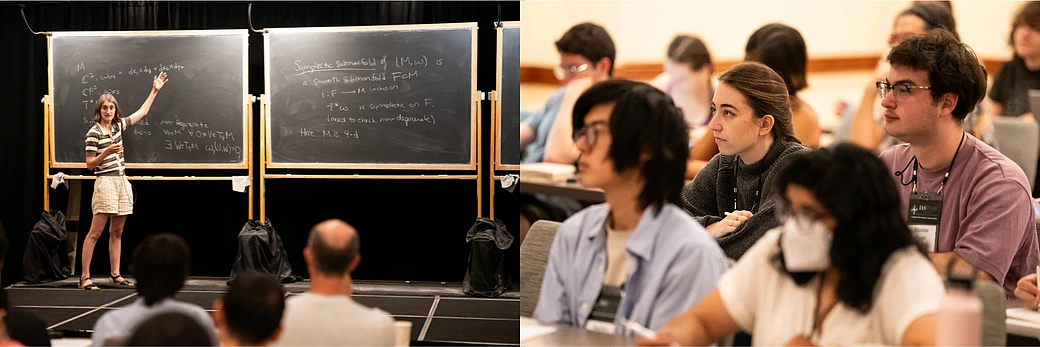
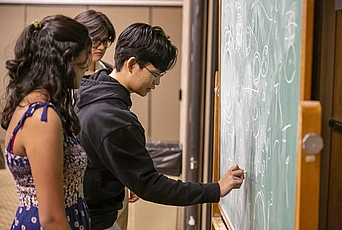
In addition to these targeted programs, PCMI also offered daily cross-program activities, which, for 2026, included engaging math talks for the entire PCMI audience, two discussions on mathematics and AI, and presentations on mathematical art. Undergraduate Summer School participants were also encouraged to attend the Experimental Math Lab, in which small groups of participants, with close mentorship from a more senior mathematician, investigated one of eight specially selected projects, ranging from explorations of spiral knots to tri-plane diagrams of knotted surfaces. This focus on curating interaction among participants from all programs is a defining feature of PCMI.
PCMI 2026 was organized by R. İnanç Baykur of the University of Massachusetts Amherst; Kyle Hayden of Rutgers University in Newark; András Stipsicz, Member (2004–05, 2011–12) in the School of Mathematics, now based at the Rényi Institute of Mathematics; Gordana Matic of the University of Georgia; Masaki Taniguchi of Kyoto University; and Ian Zemke of the University of Oregon.
The program is grateful to the Simons Foundation and the National Science Foundation (DMS-2341150) for major funding. It also received generous support from the Clay Mathematics Institute.
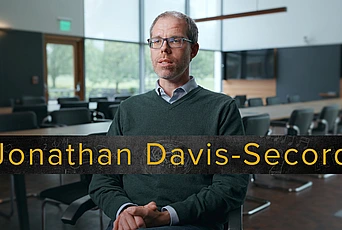
Video recordings of this year’s lectures are available on the PCMI YouTube channel.
The next iteration of PCMI, which will be held from June 27 to July 17, 2027, will focus on patterns, primes, and dynamics. Additional information about the program and a call for applications will be available on the PCMI website on or before November 1, 2026. In addition to this, PCMI currently has an open call to organize a summer session in 2028. Information about how to propose a session is available.